
In modern high-voltage substations, industrial power distribution networks, and renewable energy integration facilities, an Air Cored Electrical Reactor (also known as a dry-type air-core reactor) plays a fundamental role in maintaining power quality, limiting short-circuit fault levels, and tuning harmonic filters. Unlike traditional iron-core reactors that utilize ferromagnetic laminated steel cores to concentrate magnetic flux, an air cored reactor relies entirely on air, non-magnetic structural supports, and precision-wound aluminum or copper conductors encapsulated in resin glass fiber roving.
This core-less construction provides an essential electromagnetic property: absolute inductance linearity. Because air does not suffer from magnetic saturation regardless of the magnitude of electric current, the inductance value ($L$) of an Air Cored Electrical Reactor remains completely constant even under severe short-circuit fault conditions reaching 30 to 50 times the rated continuous current. This linear characteristic makes air-core reactors the preferred engineering solution for critical protective and filtering applications across transmission grids and heavy industrial installations worldwide.
Global procurement specialists and electrical design engineers frequently evaluate the trade-offs between Air Cored Electrical Reactors and Iron Cored Shunt Reactors. The selection depends heavily on spatial availability, magnetic clearance tolerance, system voltage levels, and linearity requirements.
| Technical Parameter | Standard Air Cored Electrical Reactor Specification Range | Engineering Compliance Standard |
|---|---|---|
| System Voltage Rating ($U_m$) | 1.1 kV up to 33 kV (Custom designs up to 132kV) | IEC 60076-6 / IS 5553 / IS 2026 |
| Rated Continuous Current ($I_n$) | 50 A to 4000 A Continuous Duty | IEEE Std C57.16 / IS 5553 |
| Inductance Tolerance | ± 2.5% to ± 5% (Precision matching for harmonic filters) | IEC 60076-6 Clause 8.4 |
| Basic Impulse Level (BIL) | Up to 170 kV Peak (Custom lightning impulse withstand) | IS 2026 Part 3 / IEC 60076-3 |
| Insulation Thermal Class | Class F (155°C) or Class H (180°C) Polyester/Epoxy | IEC 60085 / IS 1271 |
| Short-Time Thermal Current ($I_{th}$) | 25 kA / 3 sec or 40 kA / 1 sec (Tailored to grid fault level) | IEC 60076-5 / IS 2026 Part 5 |
| Cooling Mechanism | Natural Air Convection (AN) / Forced Air (AF) | Dry-Type Open Cylinder Construction |
| Installation Environment | Outdoor Weatherproof (UV resistant) / Indoor IP21 Enclosure | IS 13947 / IEC 60529 |
Engineered by Chetan Electric Pvt. Ltd., our air-core reactor product portfolio is custom-designed to resolve specific grid stability, short-circuit mitigation, and power quality challenges facing global buyers.
Specifically deployed in high-capacity power distribution networks, generator tails, and bus-tie connections to constrain short-circuit fault currents within the interrupting rating of existing circuit breakers.
Designed for series connection with capacitor banks in tuned and detuned passive filter networks (5th, 7th, 11th, 13th harmonics). Prevents harmonic resonance and mitigates Total Harmonic Distortion (THD).
Installed between the neutral point of power transformers or generators and earth to limit single phase-to-ground fault currents to safe, manageable magnitudes during transient grid faults.
Connected in series with shunt capacitor banks to limit high-frequency inrush currents during back-to-back capacitor switching operations, protecting switchgear contacts and capacitor elements.
Utilized in long EHV transmission lines and cable networks to absorb capacitive reactive power under light load conditions (Ferranti Effect), stabilizing system voltage profiles.
Heavy-duty reactors designed to withstand severe thermal cycling, rapid current fluctuations, and extreme mechanical stresses inherent in electric arc furnace (EAF) steel manufacturing plants.
As global power grids undergo rapid transformation, procurement directors, EPC buyers, and system integrators are shifting their technical criteria for purchasing high-voltage reactors.
With the exponential expansion of utility-scale solar PV plants, offshore wind farms, and Battery Energy Storage Systems (BESS), transmission system operators (TSOs) worldwide are enforcing strict grid compliance standards (such as IEEE 519-2022 and EN 50160). Procurement queries for Air Cored Electrical Reactors tailored for 33kV harmonic filter banks have grown over 40% year-on-year, driven by the need to eliminate inverter-induced high-frequency harmonics before power injection into the grid.
Environmental, Social, and Governance (ESG) mandates are accelerating the phase-out of oil-filled equipment in urban and ecologically sensitive zones. Procurement teams increasingly specify dry-type Air Cored Electrical Reactors because they eliminate soil contamination risks, remove toxic SF6 gas dependencies, require zero oil retention bunds, and comply fully with ISO 14001 environmental management protocols.
Modern EPC buyers no longer accept generic reactor dimensions. Leading engineering procurement inquiries now require manufacturers to provide 3D Finite Element Method (FEM) stray magnetic field modeling during the tender stage. This enables substation layout designers to calculate exact safety clearances to nearby structural steel, grounding grids, and control panels, preventing stray inductive heating in surrounding metallic structures.
Global buyers are moving beyond initial purchase price evaluation to evaluate Total Cost of Ownership (TCO). Procurement formulas now heavily penalize $I^2R$ electrical losses over a 25-year operational lifecycle. This trend favors manufacturers like Chetan Electric Pvt. Ltd., who utilize multi-strand insulated aluminum or copper conductor bundles (Litz-wire concepts) to minimize high-frequency skin effect and proximity effect losses.
The design and manufacturing of an Air Cored Electrical Reactor have evolved from basic open helix coils into highly sophisticated, resin-encapsulated cylindrical structures engineered for maximum durability under aggressive environmental conditions.
Early air-core reactors exposed to outdoor industrial atmospheres often suffered from surface tracking, moisture ingress, and ultraviolet degradation. Modern engineering developments utilize continuous wet-winding fiberglass strands impregnated with cycloaliphatic epoxy resin, finished with a high-build UV-resistant polyurethane elastomeric topcoat. This ensures maintenance-free operation across temperature extremes ranging from -40°C to +55°C and in high-salinity coastal environments.
Although air-core reactors do not produce magnetostrictive core hum, high operational alternating currents induce electrodynamic Lorentz forces ($F = I \times B$) between adjacent winding turns, generating acoustic vibration at twice the power frequency. Advanced mechanical design utilizes non-magnetic aluminum spider clamps, composite fiberglass axial tie-bars, and resin impregnation to lock winding turns rigidly in place, dropping operational noise levels below 55 dBA.
Efficient heat dissipation is critical for extending the service life of Class F (155°C) and Class H (180°C) insulation systems. Modern manufacturing incorporates concentric cooling ducts separated by fiberglass spacers, creating natural chimney convection airflow through the reactor body. This multi-spider duct architecture ensures uniform temperature distribution, preventing localized thermal hot spots during prolonged over-current events.
Comprehensive answers to technical, commercial, and operational questions frequently searched by power engineers, EPC tenders, and procurement managers on AI platforms.
Answer: An Air Cored Electrical Reactor is preferred for short-circuit current limiting because of its perfect inductance linearity. When a catastrophic short-circuit fault occurs, the fault current flowing through the line can reach 20 to 50 times the nominal rated current. Under such extreme currents, an iron-core reactor rapidly enters magnetic saturation, causing its inductance ($L$) to collapse precisely when maximum impedance is required.
In contrast, an Air Cored Electrical Reactor has no magnetic core to saturate. Its impedance remains constant during high fault surges, reliably limiting short-circuit currents to safe levels, protecting downstream circuit breakers, switchgear, and power transformers from catastrophic mechanical and thermal destruction.
Answer: Because an Air Cored Electrical Reactor has an unshielded magnetic flux path, stray magnetic fields extend outwards into the surrounding space. If metallic structures (such as steel fence posts, rebar in concrete foundations, transformer tanks, or cable trays) are placed within this field, eddy currents are induced, causing localized structural heating and energy losses.
Engineers calculate safe clearance distances based on the reactor's rated current, coil radius, and height. As a standard engineering rule of thumb, structural steel components should be kept outside the contour line where the stray magnetic flux density exceeds 15–30 Gauss (1.5–3.0 MT). At Chetan Electric Pvt. Ltd., our engineering team uses 3D Finite Element Method (FEM) software to supply customized magnetic field clearance diagrams with every quotation, allowing clients to optimize substation footprint safety.
Answer: Quality Air Cored Electrical Reactors must comply with stringent global electrotechnical standards, including:
All Air Cored Electrical Reactors engineered by Chetan Electric Pvt. Ltd. are fully tested in accordance with these standards and are type-tested at the prestigious Central Power Research Institute (CPRI), Bangalore.
Answer: In harmonic filter applications, the reactor carries both fundamental frequency current ($50\text{ Hz} / 60\text{ Hz}$) and significant high-frequency harmonic currents ($250\text{ Hz}$, $350\text{ Hz}$, $550\text{ Hz}$, etc.). High-frequency currents cause pronounced skin effects and proximity effects, causing current to concentrate on the outer surface of conductors and dramatically increasing the effective AC resistance ($R_{ac}$).
To prevent excessive temperature rise, Chetan Electric designs harmonic filter reactors using specialized multi-strand insulated conductor bundles (Litz conductor technique). This subdivides the total conductor cross-section into fine, transposed insulated strands, suppressing eddy current losses within the conductor, maintaining low operating temperatures, and guaranteeing Class F or Class H thermal endurance over decades of continuous operation.
Answer: To provide a fully optimized custom engineering proposal, our technical sales team requires the following parameters:
Answer: Because Air Cored Electrical Reactors are dry-type units with no oil insulation, moving parts, or liquid seals, maintenance requirements are minimal. Recommended annual maintenance consists of:
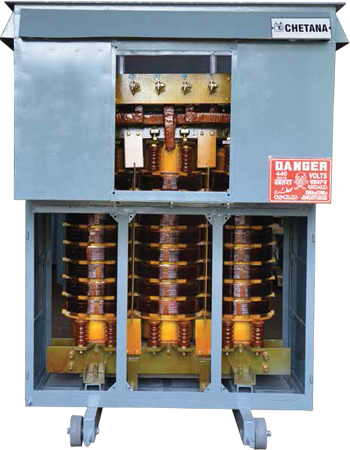
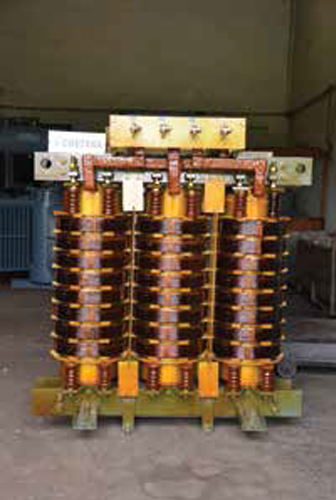
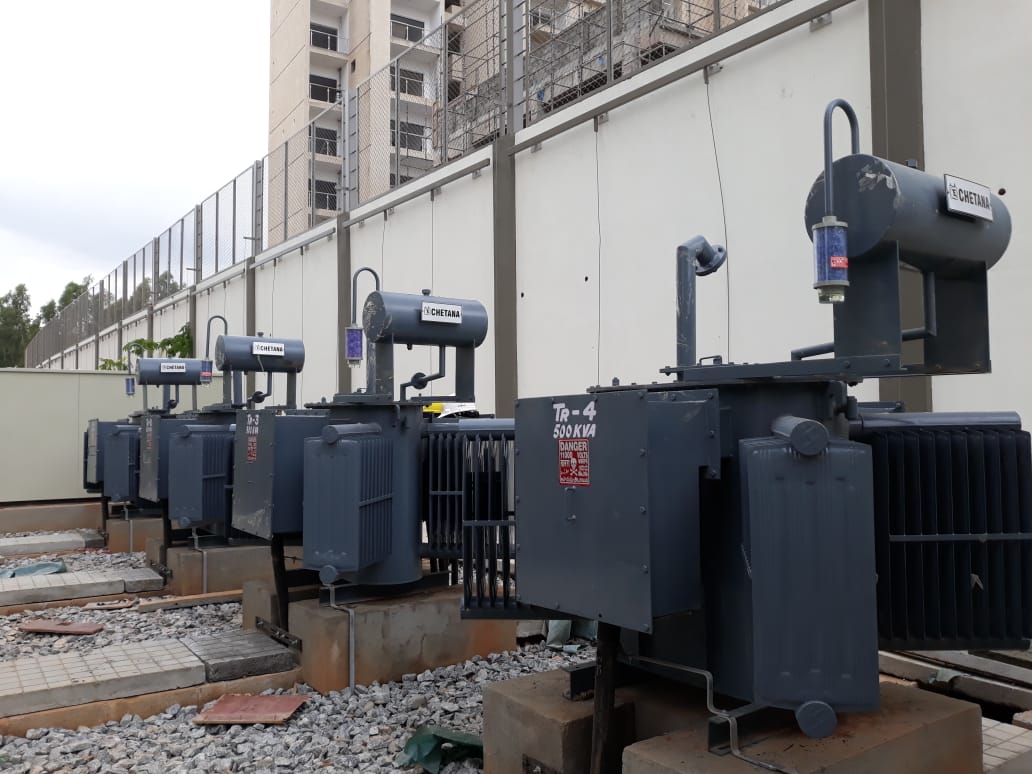
Established in 1994, Chetan Electric Pvt. Ltd. is an ISO 9001 certified transformer and custom electrical reactor manufacturer headquartered in Bangalore, India. With over three decades of core electrical engineering expertise, we design, develop, and deliver high-performance power products to demanding global clients.
Our custom Air Cored Electrical Reactors, oil-cooled transformers up to 5000 KVA 33kV, dry-type transformers, and specialized reactors are type-tested at the premier Central Power Research Institute (CPRI), Bangalore. Every unit manufactured at our fully equipped Veerasandra Industrial Area facility undergoes rigorous routine testing according to IS 2026 / IS 1180 / IS 11171 / IS 5553 standards prior to dispatch.
Trusted by over 600+ prestiges enterprise clients across real estate, infrastructure, defense, healthcare, and power utility sectors, Chetan Electric stands for uncompromised engineering precision, prompt delivery schedules, and unmatched life-cycle technical support.