
In modern electrometallurgy, steel manufacturing, chemical synthesis, and ferro-alloy smelting, the Industrial Furnace Transformer stands as the ultimate backbone of the power delivery system. Unlike standard grid-tied distribution or power transformers operating under continuous, balanced sine-wave conditions, an industrial furnace transformer is designed to perform in one of the most mechanically, thermally, and electrically hostile operating environments in heavy industry.
Furnace operations—whether involving Electric Arc Furnaces (EAF), Submerged Arc Furnaces (SAF), Ladle Refining Furnaces (LRF), or high-frequency Induction Melting units—impose repeated dead short circuits, rapid secondary voltage step-changes under load, high phase imbalance, and severe harmonic distortion. Choosing the appropriate Industrial Furnace Transformer architecture is directly tied to a plant's overall energy efficiency, tap-to-tap cycle duration, electrode consumption rates, and long-term Operational Expenditure (OPEX).
During the scrap melting phase in an Electric Arc Furnace, direct contact between graphite electrodes and cold scrap steel creates frequent sustained short circuits. These short-circuit events generate electrodynamic forces proportional to the square of the instantaneous peak current ($F \propto I_{peak}^2$). Standard transformers would experience core distortion, winding displacement, and catastrophic dielectric breakdown under these forces.
An optimized Industrial Furnace Transformer manufactured by Chetan Electric Pvt. Ltd. utilizes custom-engineered disk-type concentric windings, reinforced core clamping framing, and interleaved low-voltage busbars to neutralize radial and axial mechanical stresses. By providing exceptionally low internal impedance variation across wide voltage regulation steps, our transformers preserve grid stability while delivering peak secondary currents exceeding 50,000 Amperes.
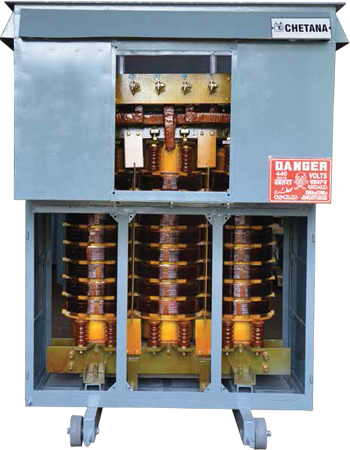
In high-current furnace transformers, up to 15% of total power loss can occur outside the core—specifically within the low-voltage terminal leads and busbar extensions. Chetan Electric implements water-cooled copper busbar tubes arranged in an interleaved phase geometry to minimize skin effect and proximity effect losses. This structural refinement increases electrical efficiency by 1.8% over standard designs, yielding up to $45,000 in annual energy savings for a typical 15 MVA continuous smelting plant.
Chetan Electric manufactures a comprehensive range of specialized furnace transformers up to 5000 KVA 33kV class, adhering to IS 2026, IS 1180, IS 11171, and IEC international standards. Select the ideal configuration matching your plant's furnace architecture:
Designed for severe cyclic loading, scrap steel melting, and rapid electrode movement. Equipped with multi-tap On-Load Tap Changers (OLTC) allowing up to 100+ daily tap operations under high current.
Engineered for continuous reduction smelting of ferro-alloys (silicon, manganese, chrome). Features high continuous thermal ratings, low secondary voltage step adjustment, and ONAF/OFWF cooling systems.
Provides precise temperature control and chemical homogenization for liquid steel secondary metallurgy. Delivers ultra-stable secondary voltage regulation with minimal harmonic distortion.
Specialized dry-type or oil-filled step-down unit feeding solid-state frequency converters. Built with electrostatic shields between primary and secondary windings to isolate high-frequency harmonics.
Global procurement teams often evaluate the structural differences when specifying transformers for heavy industrial loads. The table below outlines key technical parameters distinguishing a high-specification Industrial Furnace Transformer from a standard power transmission unit:
| Technical Parameter | Standard Power Transformer | Chetan Electric Industrial Furnace Transformer |
|---|---|---|
| Secondary Voltage & Current | Fixed secondary voltage (e.g., 11kV, 415V), low current rating. | Variable low secondary voltage (80V - 800V) with extremely high secondary currents (up to 60,000A). |
| Mechanical Withstand Force | Designed for infrequent grid short-circuit occurrences (1-2 seconds). | Built for continuous daily arc short circuits; core and windings braced to withstand 5x to 8x rated forces. |
| Tap Changing Mechanism | Off-circuit or standard OLTC with ±10% voltage variation. | Heavy-duty OLTC or motorized off-load tap changer capable of 80% to 100% voltage variation across 16-32 steps. |
| Harmonic Tolerance | Standard THD limit < 3%; subject to overheating under non-linear loads. | Custom K-Factor rated (K-13 to K-20); oversized neutral, electrostatically shielded, optimized core flux density. |
| Cooling Methodology | ONAN (Oil Natural Air Natural) or ONAF. | ONAN, ONAF, OFWF (Oil Forced Water Forced), or ODAF for compact high-heat extraction environments. |
| Busbar Termination | Standard porcelain/composite bushings. | Heavy-section copper delta-closure busbar extensions projecting directly through tank walls or top cover. |
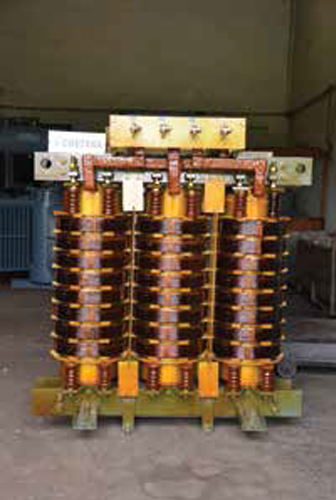
When sourcing an Industrial Furnace Transformer, engineering departments must evaluate criteria beyond initial purchase price (CAPEX). Total Cost of Ownership (TCO) dictates that operational reliability and thermal withstand capacity are paramount:
As the global steel and metallurgical sectors pivot toward decarbonization, green steel production, and Industry 4.0 automation, the design requirements for Industrial Furnace Transformers are undergoing a significant evolution. Key procurement trends shaping the industry include:
The transition from blast furnaces to Direct Reduced Iron (DRI) coupled with Electric Arc Furnaces (EAF) powered by renewable energy requires furnace transformers to handle intermittent green power feeds. Future furnace transformers will feature adaptive vector group shifting and hybrid insulation liquids (natural esters) to support zero-carbon steel manufacturing.
Unplanned downtime in a steel meltshop can cost upwards of $30,000 per hour. Modern buyers now mandate smart sensor arrays integrated directly into the transformer housing. Chetan Electric equips advanced units with online Dissolved Gas Analysis (DGA), fiber-optic real-time winding temperature sensors, and vibration monitoring nodes that transmit diagnostic data directly to cloud-based predictive maintenance systems.
Replacing traditional mineral oil with synthetic or natural ester fluids elevates the fire point from 140°C to over 300°C (K-class fluids). This trend allows industrial plants to place furnace transformers closer to the arc furnace inside primary buildings without requiring expensive fire-wall barriers or deluge systems.
For induction melting applications, hybrid transformer systems combining copper-wound power transformers with IGBT-based solid-state converters are reducing total power consumption per ton of melted steel by up to 8%.
Founded in 1994 in Bangalore, India, Chetan Electric Pvt. Ltd. has established an unyielding reputation over 30+ years as an ISO 9001 certified pioneer in custom transformer manufacturing. Our technical authority rests on a foundation of rigorous testing, custom engineering, and proven client performance.
Years Engineering Heritage
Global Industrial Clients
Type-Tested Certified Quality
33kV Manufacturing Limit
Every transformer leaving our manufacturing plant at Veerasandra Industrial Area, Bangalore undergoes exhaustive routine tests in strict compliance with IS 2026 / IS 1180 / IS 11171 standards. Our products have been independently type-tested and certified by the Central Power Research Institute (CPRI), Bangalore, validating our short-circuit withstand capabilities and impulse voltage withstand levels.
Trusted by premier industrial developers, government institutions, and defense enterprises—including Prestige Group, Sobha Developers, ISRO, BEML, BEL, Brigade Group, and Salarpuria Properties—Chetan Electric combines corporate stability with nimble, tailored engineering response times.
Below are authoritative answers to common technical queries raised by global procurement managers, electrical consultants, and plant engineers when evaluating furnace transformers:
Whether you require an Electric Arc Furnace Transformer, Submerged Arc Furnace Transformer, or specialized Rectifier Unit, Chetan Electric Pvt. Ltd. delivers custom-engineered precision backed by 30+ years of industrial excellence.
Contact Us