
Engineered for high-voltage dielectric insulation withstand testing, partial discharge (PD) measurements, and laboratory quality assurance up to 150kV+. Manufactured to strict IEC 60060-1, IEC 60270, and IS 2071 standards with CPRI-certified performance.
Get CatalogIn modern electrical power engineering, the operational integrity of high-voltage apparatus—such as power transformers, switchgear, XLPE cables, bushings, and surge arresters—hinges entirely on the quality of their insulation systems. A Power Frequency Test Transformer serves as the fundamental cornerstone of high-voltage (HV) test laboratories, component manufacturing plants, and electrical research institutions worldwide.
Unlike standard step-up distribution transformers, a high-voltage power frequency test transformer is specifically optimized to supply stable, low-distortion sinusoidal AC voltage at supply power frequencies (50 Hz or 60 Hz). Designed to endure frequent short-circuits caused by test object breakdown, these units deliver exceptional voltage regulation, low partial discharge (<3 pC), and absolute dielectric stability under rigorous capacitive load conditions.
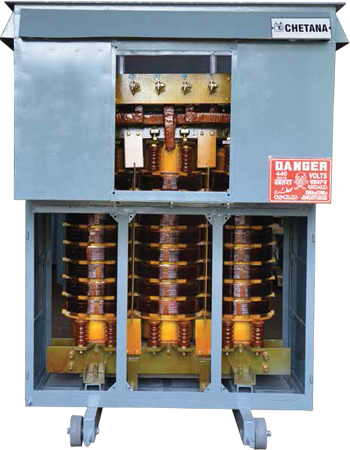
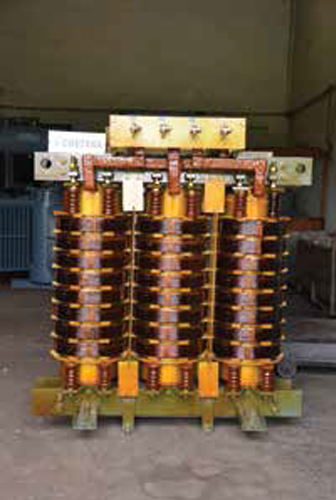
Chetan Electric Pvt. Ltd. manufactures a wide spectrum of power frequency test transformers custom-built to match specific test laboratory setups, duty cycles, and partial discharge noise thresholds. Depending on the test dielectric medium, space constraints, and voltage level, global buyers can select across three major product families:
The table below provides a comprehensive overview of Chetan Electric’s standard high-voltage power frequency test transformer series. Every unit can be custom-engineered to meet non-standard secondary voltages, specialized duty cycles, or tighter PD thresholds upon request.
| Model Rating | Rated Capacity (kVA) | Primary Voltage (V) | Secondary Voltage (kV) | Partial Discharge Level | Impedance Voltage (%) | Duty Cycle Rating | Insulation Medium |
|---|---|---|---|---|---|---|---|
| CE-PFT-10/50 | 10 kVA | 220V / 400V | 50 kV | < 5 pC at 100% Un | < 8% | 30 Min / 1 Hour | High-Grade Mineral Oil |
| CE-PFT-25/100 | 25 kVA | 230V / 415V | 100 kV | < 3 pC at 100% Un | < 6.5% | 1 Hour / Continuous | Oil Immersed / SF6 Gas |
| CE-PFT-50/150 | 50 kVA | 380V / 415V | 150 kV | < 3 pC at 100% Un | < 7.0%Continuous (24/7) | Oil / Insulating Cylinder | |
| CE-PFT-100/250 | 100 kVA | 415V / 3300V | 250 kV | < 2 pC at 100% Un | < 5.5% | Continuous (24/7) | Cascaded Oil Unit |
| CE-PFT-300/500 | 300 kVA | 3.3kV / 6.6kV | 500 kV | < 2 pC at 100% Un | < 5.0% | Continuous (24/7) | Multi-Stage Cascade |
Global procurement teams often evaluate power frequency test transformers purely on kVA and output kV. However, as senior high-voltage design engineers, we know that true operational reliability resides in three critical structural parameters that separate world-class test transformers from substandard models:
High-voltage stress concentration at terminal connections leads to localized air ionization (corona discharge). This corona creates electrical noise that completely ruins sensitive partial discharge measurements. Chetan Electric integrates custom-profiled aluminum gradient rings and toroidal electrostatic shields. This flattens the electric field distribution gradient around the HV bushing, ensuring electrical background noise remains strictly below international PD limits (IEC 60270).
When a test object (e.g., insulator or cable sample) experiences flashover or dielectric breakdown during withstand testing, the test transformer experiences an instantaneous direct short circuit. This generates immense electrodynamic radial and axial forces within the core and coils. Our windings are constructed using high-density thermally upgraded pressboard spacers and epoxy-coated copper conductors, clamped under high static pre-compression forces. This prevents winding displacement or turn-to-turn mechanical distortion over decades of repetitive breakdowns.
Core saturation causes harmonic distortion in the high-voltage sinusoidal wave. Harmonic distortion skewing the peak-to-RMS voltage ratio ($\sqrt{2}$) compromises test accuracy mandated by IEC 60060-1. We utilize high-permeability, cold-rolled grain-oriented (CRGO) magnetic silicon steel sheets with step-lap mitered joints. This minimizes magnetizing current distortion and guarantees a clean, pure 50Hz/60Hz output waveform under zero-load to full-load operation.
As power distribution grids transition toward smart grid infrastructure, renewable energy integration (solar/wind farms), and ultra-high voltage DC (UHVDC) transmission lines, the requirements placed on power frequency test systems are undergoing rapid technological transformation:
1. Shift Toward Automated & Digital AI Test Consoles: Procurement managers are phasing out manual step-up variac controllers. Modern test bays demand micro-processor PLC control desks integrated with automated voltage ramp rates, digital peak-voltmeter readings, automated trip current setups, and cloud-connected report generation.
2. Integration with Real-Time Acoustic & Electrical PD Diagnostics: A simple high-voltage withstand pass/fail test is no longer sufficient for grid asset management. Modern procurement tenders mandate power frequency test transformers with ultra-clean electrical backgrounds (< 2pC) to enable high-sensitivity phase-resolved partial discharge (PRPD) pattern analysis during routine factory testing.
3. Biodegradable Synthetic Ester Fluid Adoption: Environmental sustainability standards are pushing high-voltage testing labs to replace conventional mineral oil with non-toxic, eco-friendly synthetic ester fluids. Synthetic ester oils provide higher fire points (>300°C) and extended moisture tolerance without sacrificing dielectric insulation strength.
One of the most frequent errors in international B2B procurement is under-sizing the kVA capacity of the power frequency test transformer when testing high-capacitance apparatus (such as long power cables or generator windings). The capacitive current $I_c$ drawn by a test object at rated test voltage is calculated using the standard formula:
$I_c = 2 \cdot \pi \cdot f \cdot C_x \cdot U_{test}$
Where:
The required apparent power rating $S$ (in kVA) of the power frequency test transformer is then determined by:
$S (kVA) = U_{test} \cdot I_c \cdot 10^{-3} \cdot K_{safety}$
Where $K_{safety}$ is a safety margin factor (typically 1.2 to 1.35) designed to account for stray capacitance of HV leads, corona rings, and potential transient overcurrents. Purchasing officers must verify both continuous capacitive current demand and maximum short-duration withstand duty when requesting quotations.
When procuring high-voltage AC test equipment, buyers frequently ask whether to select a conventional power frequency test transformer or a Variable Frequency Resonant Test System (VFRTS). Below is a direct engineering comparison to guide your procurement strategy:
| Evaluation Criterion | Power Frequency Test Transformer | Variable Frequency Resonant Test System |
|---|---|---|
| Primary Application | Laboratory testing of switchgear, bushings, transformers, insulators, short cable runs. | On-site commissioning of long high-capacitance XLPE power cables, GIS substations. |
| Output Waveform Quality | Pure 50Hz / 60Hz power frequency sinusoidal output matching power grid conditions. | Variable frequency (20 Hz - 300 Hz) quasi-sinusoidal output depending on load tuning. |
| Weight & Portability | Heavier steel tank or insulating cylinder; best suited for fixed factory/lab installation. | Lighter power supply module, highly portable for field testing. |
| Breakdown Energy Hazard | High breakdown energy during specimen flashover unless limited by damping resistor. | Low breakdown energy; resonance instantly collapses upon flashover, protecting test specimen. |
| Initial Investment Cost | Cost-effective, low maintenance, simpler operating control circuitry. | Higher initial capital investment and complex electronic variable frequency drive modules. |
Established in 1994 in Bangalore, India, Chetan Electric Pvt. Ltd. brings over three decades of precision manufacturing expertise to the global power transformer market.
Our test transformers are rigorously type-tested at the prestigious Central Power Research Institute (CPRI), validating impulse voltage withstand and dielectric stability.
Every stage—from CRGO core slitting and coil vacuum drying to dielectric oil degassing—is strictly governed by certified ISO 9001 quality assurance workflows.
Our specialized winding geometry and vacuum oil impregnation processes achieve certified partial discharge levels below 3 pC at full rated voltage.
Proud supplier to defense, aerospace, healthcare, and infrastructure giants including ISRO, BEL, BEML, Prestige Group, and major state electricity boards.
We don't just sell transformers; we design complete high-voltage test bays including control consoles, voltage dividers, filter units, and grounding switches.
Over the past 30+ years, Chetan Electric has delivered over 5,000 high-performance transformers to more than 600 satisfied institutional clients. Our power frequency test transformers operate in critical aerospace laboratories, high-voltage equipment manufacturing factories, and utility research facilities across the globe.
Whether you are establishing a new ISO 17025 accredited high-voltage testing facility, upgrading an existing factory QA line, or sourcing replacement equipment for utility grid maintenance, Chetan Electric provides custom-engineered solutions tailored to your operational specifications.
A Power Frequency Test Transformer is designed to generate a high-voltage AC output at supply power frequencies (50Hz or 60Hz) to perform electrical insulation withstand tests and partial discharge (PD) measurements. It verifies that electrical apparatus—such as transformers, cables, switchgear, insulators, and bushings—can safely handle overvoltages during normal grid operation and switching surges without insulation breakdown.
Partial discharge is a localized dielectric breakdown of a small portion of a solid or liquid electrical insulation system under high voltage stress. If a test transformer itself generates high partial discharge background noise (e.g., > 10 pC), it will obscure the actual PD signals originating from the test object. Low-PD test transformers (<3 pC or <2 pC) ensure accurate diagnostic measurement of insulation quality in compliance with IEC 60270.
Chetan Electric achieves ultra-low PD performance through meticulous design and manufacturing controls: using rounded conductor edges to eliminate sharp field concentrations, employing high-vacuum oil degasification and moisture removal, incorporating toroidal electrostatic shielding rings, and utilizing bubble-free vacuum epoxy casting or oil impregnation processes.
A continuous duty rating (100% duty cycle) allows the test transformer to operate indefinitely at rated current and voltage without exceeding thermal temperature rise limits—ideal for long-duration partial discharge thermal endurance testing. A short-time duty rating (e.g., 5 min, 15 min, or 1 hour) allows a smaller physical transformer footprint and lower cost if testing is restricted to brief routine 60-second high-voltage withstand tests.
A robust test system includes: a high-speed over-current relay to trip the input power upon test object breakdown, an over-voltage protection circuit, zero-voltage start interlocks to prevent energizing at high variac positions, protective damping resistors in series with the HV terminal to limit breakdown current, and fast-acting grounding switches for operator safety.
Yes. Chetan Electric provides fully integrated high-voltage test solutions, including manual auto-transformer control desks, fully automated PLC touch-screen operator consoles, digital crest voltmeters, capacitive voltage dividers, partial discharge detectors, and isolation filters.
Our test transformers are designed, manufactured, and tested in accordance with IEC 60060-1 (High-Voltage Test Techniques), IEC 60270 (Partial Discharge Measurements), IS 2071 (Methods of High Voltage Testing), IS 2026 (Power Transformers), and IEEE Std 4 (IEEE Standard Techniques for High-Voltage Testing).
You can request a complete engineering catalog, dimensional outline drawings, and custom technical proposal by clicking the Get Catalog button on this page or contacting our technical sales desk via email at [email protected] or telephone at +91 9341239953.
Consult directly with our high-voltage design team to configure the ideal Power Frequency Test Transformer system for your quality lab or manufacturing plant.
Get Catalog