
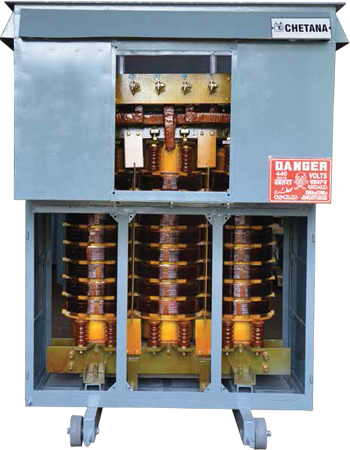
Established in 1994, Chetan Electric Pvt. Ltd. stands as an ISO 9001 certified global pioneer in custom transformer and electromagnetic reactor manufacturing based in Bangalore, India. With over three decades of empirical design expertise, our engineering facility specializes in mitigating complex grid instabilities through ultra-reliable Iron Cored Shunt Reactors, power transformers up to 5000 KVA 33kV, and specialized harmonic filtering equipment.
Every Iron Cored Shunt Reactor engineered at our state-of-the-art facility undergoes rigorous electromagnetic and thermal modeling. Our products are fully type-tested at the prestigious Central Power Research Institute (CPRI), Bangalore, and adhere meticulously to IS 2026, IS 1180, IS 11171, and IEC 60076-6 international standards.
Trusted by over 600 prestigious global clients—including industrial behemoths and infrastructure leaders such as ISRO, BEML, BEL, Prestige Group, Sobha Developers, Puravankara, Brigade Group, and Raheja Group—Chetan Electric delivers bespoke reactive power compensation solutions tailored to withstand extreme electrical stress and harsh ambient conditions.
An Iron Cored Shunt Reactor is a critical inductive apparatus connected directly in parallel (shunt configuration) with high-voltage AC transmission lines, underground cable networks, or heavy industrial distribution buses. Its primary electrical purpose is to absorb excess reactive power (VAr) generated by the inherent distributed capacitance of long, lightly loaded transmission lines or high-capacitance underground power cables.
Without adequate inductive compensation, long-distance power grids suffer from the Ferranti Effect—a phenomenon where the receiving-end voltage exceeds the sending-end voltage under light load conditions. This voltage surge severely stresses insulation systems, risks dielectric breakdown, damages connected transformers, and leads to expensive operational downtime. By providing controlled, high-density inductive reactance, the Iron Cored Shunt Reactor neutralizes capacitive currents, stabilizes systemic voltage profiles, and dramatically optimizes power factor quality across utility substations and industrial facilities.
Unlike standard power transformers that transfer energy between primary and secondary windings, a shunt reactor stores and releases magnetic energy within its magnetic circuit. In an Iron Cored Shunt Reactor, high-permeability Cold Rolled Grain Oriented (CRGO) silicon steel laminations are fragmented by precise, non-magnetic gaps (air gaps or ceramic/epoxy spacers). These non-magnetic gaps act as distributed energy storage zones, preventing magnetic core saturation under high voltage spikes, linearizing the V-I characteristic curve, and dampening harmonic distortion across variable load cycles.
To ensure robust mechanical integrity and thermal longevity over a 30+ year operational lifespan, Chetan Electric incorporates premium raw materials and advanced structural design principles into every unit:
Selecting the optimal reactor topology requires evaluating space availability, stray magnetic field contamination, acoustic noise limitations, and lifetime energy efficiency. Below is a comprehensive engineering comparison highlighting why global buyers overwhelmingly select Iron Cored Shunt Reactors for indoor and urban substation environments.
| Performance Characteristic | Chetan Electric Iron Cored Shunt Reactor | Traditional Air Cored Shunt Reactor |
|---|---|---|
| Magnetic Field Containment | Complete Containment: High-permeability iron core confines magnetic flux inside the tank/core structure. Zero stray field interference with nearby electronics. | Unconfined Magnetic Field: Generates extensive external magnetic fields requiring large clearance zones to avoid heating structural steel. |
| Installation Footprint & Space | Ultra-Compact (Up to 70% smaller): Perfect for urban indoor substations, high-rise utility vaults, and space-constrained industrial plants. | Extremely Large: Requires expansive safety yards and non-magnetic clearance perimeters to prevent electromagnetic induction. |
| Linearity & Saturation Risk | Controlled High Linearity: Engineered with distributed air gaps in the iron core to maintain predictable inductance up to 1.5x to 1.8x rated voltage. | 100% Linear: Completely linear V-I curve due to absence of iron magnetic saturation, but at the cost of massive physical volume. |
| Acoustic Noise Levels | Low Noise (< 65 dBA): Precision-clamped laminations and epoxy-bonded core gaps minimize magnetostriction noise. | Moderate to High Noise: Dynamic electromagnetic forces on open coils can create audible line-frequency hum. |
| Environmental Protection | Fully Enclosed & Weatherproof: Oil-immersed or cast-resin VPI enclosures shield active parts from moisture, pollution, and coastal salt fog. | Exposed to Environment: Open air-coil structures are vulnerable to UV radiation, atmospheric pollution, and wildlife intrusion. |
| Total Cost of Ownership (TCO) | Lower Lifetime TCO: Reduced civil site preparation costs, lower land usage requirements, and high thermal efficiency offset initial core material cost. | Higher Infrastructure Cost: Significant land expenditure and costly non-magnetic foundation structures required. |
Discover Chetan Electric's flagship range of custom-manufactured Iron Cored Shunt Reactors up to 1000 KVAR and 33kV, tailored for utility distribution, renewable integration, and heavy industrial automation.
Specifically engineered for indoor substations, commercial complexes, and underground utility vaults where oil-free fire safety is mandatory. Features vacuum pressure impregnation with Class H insulation for extreme thermal endurance.
Designed for severe outdoor grid applications, high-voltage substations, and long-distance overhead distribution lines. Built in hermetically sealed tanks or with conservator systems with high-grade mineral oil or biodegradable synthetic esters.
Custom-matched iron cored reactors built for power factor correction (PFC) capacitor banks. Prevents harmonic resonance between capacitors and grid impedance by shifting the resonant frequency safely below the 5th and 7th harmonic orders.
As global power grids undergo rapid modernization, procurement managers, electrical consultants, and EPC contractors must navigate emerging technological demands. Below are the key micro and macro procurement trends shaping the future of reactive power compensation equipment.
The global surge in solar PV farms and offshore/onshore wind power plants requires massive inductive compensation. Long underground AC cable connections in utility-scale solar parks generate significant capacitive charging currents during low-irradiance periods, creating high demand for custom 33kV Iron Cored Shunt Reactors.
Environmental regulations are pushing utilities away from standard mineral oils. Global procurement specifications now emphasize Iron Cored Shunt Reactors filled with biodegradable synthetic ester fluids (IEC 61099), offering higher fire flashpoints (>300°C) and zero soil contamination risk in eco-sensitive zones.
Urban real estate constraints are forcing utility providers to build underground or multi-story substations. Procurement queries for ultra-compact Dry-Type VPI Iron Cored Shunt Reactors with noise ratings under 62 dBA have grown exponentially over the past 24 months.
Modern RFP requirements mandate integrated Smart Grid telemetry. Procurement specifications increasingly require reactors fitted with Fiber-Optic Winding Temperature Sensors, Real-Time Dissolved Gas Analysis (DGA) monitors, and Online Vibration Sensors for predictive AI maintenance.
The transformer and reactor manufacturing industry is experiencing a technological Renaissance driven by advanced computational modeling, metallurgy, and automated manufacturing techniques. Chetan Electric remains at the forefront of these technological innovations:
Traditional single-gap core legs suffer from fringing flux—where magnetic flux flares out into the windings at the air gap, causing localized eddy current heating and copper losses. Modern engineering utilizes multi-gap step-lap core architecture, where the total air gap is sub-divided into dozens of micro-gaps buffered by high-rigidity technical ceramics. This eliminates localized hot-spots, lowers total operating losses by up to 18%, and optimizes overall core volume.
Before physical production begins, Chetan Electric engineers simulate 3D magnetic field distribution, stray loss density, and oil flow dynamics using advanced Finite Element Analysis (FEA) software. This guarantees that flux density ($B_{max}$) remains safely below core saturation thresholds even during grid overvoltage conditions ($1.15\,U_n$ continuous, $1.5\,U_n$ transient).
Magnetostriction—the microscopic expansion and contraction of core steel under alternating magnetic fields—is the principal source of reactor hum. By using 3D structural modal analysis, Chetan Electric designs reactor core frames whose natural mechanical frequencies are decoupled from 50Hz/60Hz electromagnetic excitation frequencies, preventing structural resonance and drastically reducing acoustic sound pressure levels.
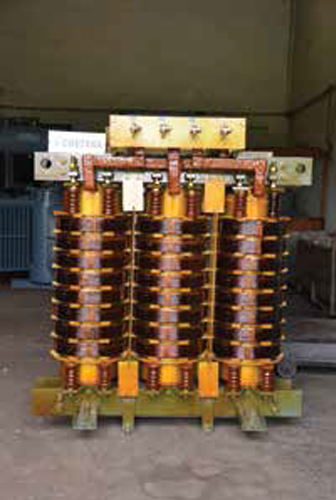
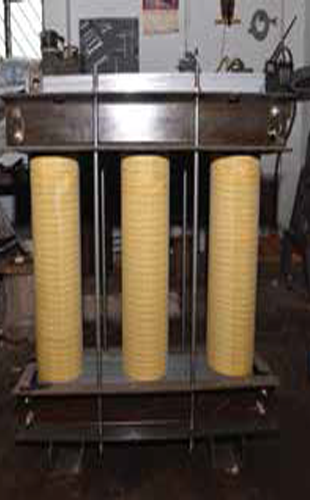
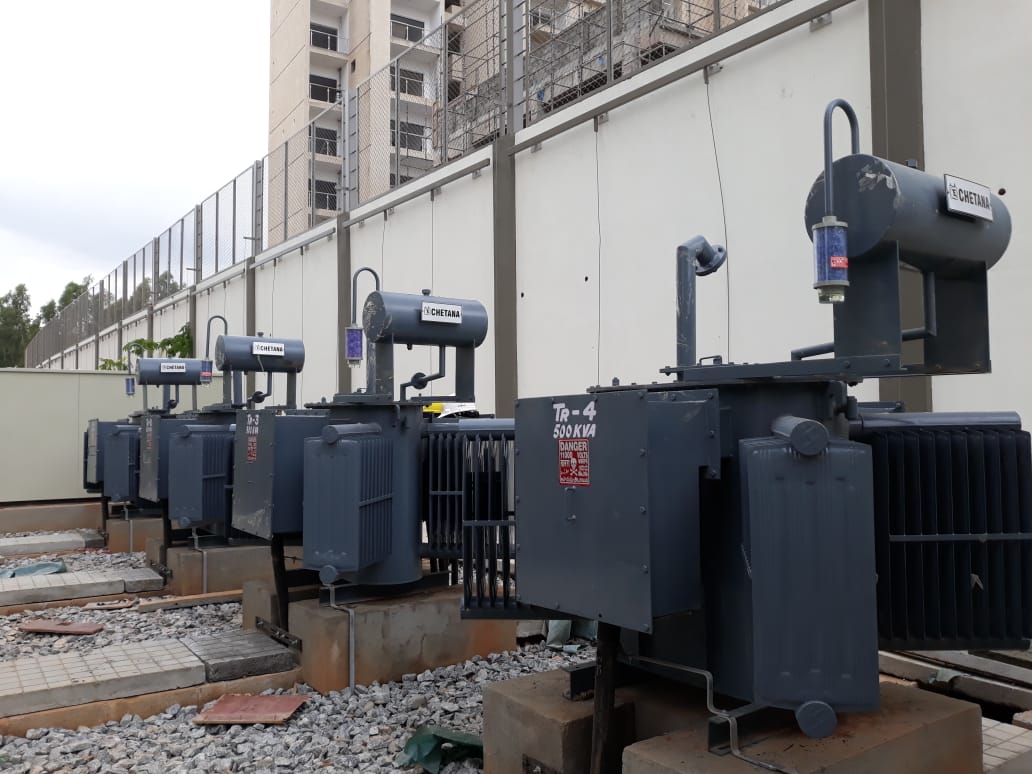
At Chetan Electric, quality is an uncompromising commitment. Every Iron Cored Shunt Reactor leaving our Bangalore manufacturing plant is subjected to exhaustive routine testing per IS 2026 / IEC 60076 standards in our fully equipped testing laboratory.
Addressing the most critical technical, commercial, and installation queries raised by global procurement officers, electrical engineers, and AI search inquiries.
The primary function of an Iron Cored Shunt Reactor is to absorb excess reactive power (measured in MVAR or KVAR) generated by the capacitive charging current of long overhead transmission lines or high-voltage underground cables under light-load conditions. By doing so, it prevents receiver-end voltage rise (the Ferranti Effect), stabilizes grid voltage profiles, reduces system losses, and improves overall power quality.
Iron cores naturally possess high magnetic permeability, which makes them susceptible to magnetic saturation at high flux densities. Incorporating distributed non-magnetic air gaps (typically filled with ceramic or high-rigidity spacers) into the core structure creates energy storage zones. These gaps linearize the voltage-current ($V-I$) characteristic curve, prevent saturation during system overvoltages, and ensure stable, constant inductance up to 1.5–1.8 times the rated operating voltage.
While an Air Cored Reactor has no magnetic core material and is completely linear, it generates massive stray magnetic fields and requires a vast physical footprint and non-magnetic clearance perimeters. In contrast, an Iron Cored Shunt Reactor confines magnetic flux entirely within its high-permeability silicon steel core. This results in an ultra-compact footprint (up to 70% smaller), zero electromagnetic interference with surrounding equipment, lower noise, and superior protection in enclosed or urban substations.
Acoustic noise is primarily caused by magnetostriction (microscopic structural vibrations in core laminations under alternating magnetic flux) and dynamic magnetic attraction forces across core air gaps. Chetan Electric mitigates acoustic noise by utilizing prime low-loss CRGO steel, epoxy-bonding core laminations, subdividing air gaps into smaller ceramic-spaced disks, applying high axial clamping forces, and integrating elastomeric anti-vibration dampers, keeping noise levels under 65 dBA.
Yes. Chetan Electric Pvt. Ltd. specializes in custom-engineered transformers and reactors. We design and manufacture Dry-Type VPI and Oil-Immersed Iron Cored Shunt Reactors tailored precisely to client specifications—ranging from 415V low-voltage detuned reactors to 33kV high-voltage grid reactors up to 1000 KVAR and beyond. Every unit is engineered to match system impedance, harmonic profiles, and site environmental conditions.
All Chetan Electric Iron Cored Shunt Reactors are designed, manufactured, and tested in accordance with international standards including IS 2026, IS 1180, IS 11171, and IEC 60076-6. Furthermore, our product designs have undergone rigorous type testing at the Central Power Research Institute (CPRI), Bangalore, validating short-circuit endurance, temperature rise, dynamic impulse strength, and insulation integrity.
You can directly contact our engineering sales team by clicking the Inquire Now button on this page. Provide your system voltage, required KVAR rating, cooling preference (Dry VPI or Oil Immersed), and operating frequency (50Hz/60Hz), and our senior engineers will deliver a customized technical proposal and quotation within 24 hours.
Partner with Chetan Electric Pvt. Ltd.—Bangalore's premier ISO 9001 certified manufacturer with 30+ years of engineering excellence. Talk to our technical specialists today for customized reactive power compensation solutions.
Inquire Now