Understanding High Voltage Testing Transformer Architecture in Modern Electrical Infrastructure
In high-voltage electrical engineering and equipment manufacturing, dielectric integrity is the ultimate boundary condition determining operational safety, asset longevity, and grid reliability. A High Voltage Testing Transformer (HVTT) is a highly specialized electrical apparatus specifically designed to supply high alternating current (AC) voltages at power frequencies (50 Hz / 60 Hz) for insulation withstand tests, dielectric breakdown analysis, partial discharge (PD) measurements, and routine quality assurance testing across high-voltage cables, switchgear, bushings, power transformers, and insulating materials.
Unlike standard power distribution transformers operating continuously at rated step-up or step-down ratios under balanced thermal equilibrium, a high voltage test transformer must endure repetitive electrical stresses, sudden dielectric flashovers, capacitive current spikes, and short-circuit conditions during test specimen failure. Consequently, engineering a reliable test transformer demands ultra-high dielectric strength insulation systems, specialized magnetic core geometry, steep transient overvoltage suppression, and minimal partial discharge levels—frequently below 3 pico-Coulombs (pC) at 100% rated test voltage.
Global industrial procurement teams, electrical compliance directors, and testing laboratory managers evaluating high voltage test equipment must analyze parameters beyond primary KVA ratings. Modern B2B procurement decisions require evaluating the unit’s short-circuit current limiting impedance, voltage regulation fidelity under highly capacitive test loads, cascading extension capabilities, and total thermal-cycle withstand during prolonged endurance testing.
Technical Distinction: Power Distribution Transformers vs. High Voltage Testing Transformers
While standard power transformers emphasize maximum energy efficiency (low core/copper losses) under constant continuous loading, a High Voltage Testing Transformer prioritizes extreme high-voltage dielectric isolation, high short-duration thermal capacity, low internal capacitance, and exceptional resistance to repetitive secondary terminal short-circuits caused by dielectric flashovers of the tested object.
High Voltage Testing Transformer Product Recommendations & Topologies
Selecting the optimal test transformer architecture depends directly on the capacitive load of the Test Object (DUT - Device Under Test), required breakdown voltage threshold, continuous vs. intermittent duty cycle, and installation mobility demands. Chetan Electric Pvt. Ltd. manufactures a complete range of precision-engineered High Voltage Testing Transformers tailored for diverse laboratory and field environments.
Single-Phase Tank Type HV Test Transformers
Engineered with heavy-duty metal tanks and high-grade mineral insulating oil or synthetic esters. Features built-in primary filter windings and oil-immersed high-voltage bushings suitable for high-voltage testing up to 150kV AC. Designed for continuous laboratory withstand testing and high-power dielectric diagnostics with ultra-low partial discharge output.
Cascading High Voltage Testing Systems
For ultra-high voltage applications exceeding 150kV up to 750kV AC, cascading systems utilize multiple insulated-shell transformer units connected in series. Each cascade unit incorporates an excitation winding, high-voltage winding, and coupling winding, significantly reducing ground insulation dimensions, transport weight, and floor space requirements in HV test halls.
Dry-Type & Cast Resin HV Test Transformers
Manufactured using Vacuum Pressure Impregnation (VPI) or vacuum cast epoxy resin technology for cleanroom, explosive-hazard, and indoor installation environments. Completely eliminates oil-handling requirements while providing robust impulse voltage withstand, fire safety, and compact physical footprint up to 50kV power frequency testing.
Engineering Specification Matrix: Chetan Electric HV Test Transformers
The table below provides detailed engineering benchmarks across standard and custom-configured High Voltage Testing Transformers developed by Chetan Electric for global buyers:
| Transformer Model Series | Primary Voltage (V) | Secondary Test Voltage (kV AC) | Rated Capacity (kVA) | Partial Discharge Level | Insulation & Cooling | Primary Application Scope |
|---|---|---|---|---|---|---|
| CET-HV-50T | 220V / 415V | 0 – 50 kV | 5 kVA – 50 kVA | < 5 pC at 100% Un | Oil-Immersed (ONAN) | Switchgear, CT/PT & Insulated Tool Testing |
| CET-HV-100T | 230V / 415V | 0 – 100 kV | 10 kVA – 100 kVA | < 3 pC at 100% Un | Oil-Immersed (ONAN) | MV Power Cables, Bushings & Insulator Testing |
| CET-HV-150T | 415V / 600V | 0 – 150 kV | 20 kVA – 200 kVA | < 3 pC at 100% Un | Oil-Immersed (ONAN) | CPRI Type Testing, HV Motors & Substation Gear |
| CET-HVC-300C | 415V Cascade | 0 – 300 kV (Cascaded) | 50 kVA – 500 kVA | < 5 pC at 100% Un | Cascaded Insulated Cylinders | UHV Laboratory Breakdown & Research Testing |
| CET-HVD-30 | 220V / 240V | 0 – 30 kV | 2 kVA – 25 kVA | < 10 pC at 100% Un | Dry-Type VPI / Epoxy Cast | Indoor Cleanrooms, OEM Assembly Line Testing |
Precision Coils & Low-PD Insulation Architecture
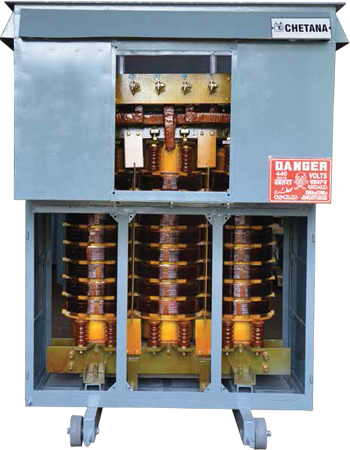
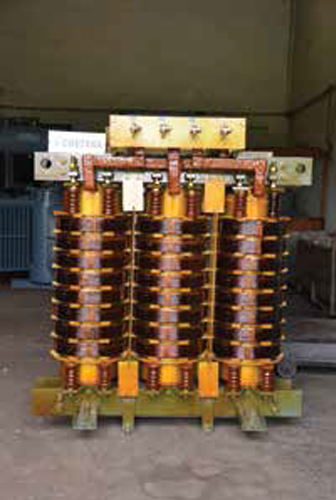
At Chetan Electric's advanced transformer manufacturing facility in Bangalore, high voltage test transformers are wound with high-purity electrolytic grade copper conductors insulated with multiple layers of high-dielectric Nomex and kraft paper. Every high-voltage coil undergoes precision tension control to eliminate internal mechanical gaps, preventing local electric field concentration and micro-void partial discharge generation during extended dielectric withstand tests.
Furthermore, magnetic cores are constructed using prime, high-permeability Cold Rolled Grain Oriented (CRGO) silicon steel laminations stacked in step-lap joints. This guarantees minimal excitation magnetizing current and ultra-low noise distortion, providing pure sinusoidal voltage waveforms necessary for accurate tan-delta (dissipation factor) and PD measurements.
Future Procurement & Technology Trends in High Voltage Testing Transformers
As global power distribution networks transition toward higher operating voltages, renewable energy integration, and smart grid automation, the demand for sophisticated, reliable high-voltage testing equipment is accelerating rapidly. B2B procurement managers and system integrators must anticipate several major technological trends shaping the high-voltage test transformer landscape over the coming decade:
1. Integration with Digital Twin & Automated Control Systems
Modern high voltage test set setups are moving away from manual variable autotransformer (Variac) knobs toward fully automated PLC-driven control consoles. Future-ready test transformers feature integrated fiber-optic voltage sensors, automated voltage ramp-rate programming (compliant with IEC 60060-1), automatic breakdown detection, and real-time cloud data logging with Digital Twin diagnostic modeling.
2. Biodegradable Synthetic Esters & Environmentally Friendly Fluids
Environmental regulations and fire safety standards in urban testing facilities are driving the replacement of traditional mineral oils with high-fire-point natural and synthetic ester fluids. These biodegradable insulating dielectric liquids offer breakdown voltages exceeding 75 kV (per IEC 60156), higher moisture tolerance, and zero environmental bioaccumulation risk.
3. Variable Frequency Resonant Test Systems Integration
For testing long underground MV/HV power cables and gas-insulated substations (GIS) with high capacitive reactance, continuous power frequency testing requires massive reactive power. Procurement is increasingly shifting toward combining HV test transformers with variable frequency excitation units (20 Hz – 300 Hz) to create resonant test systems, reducing input power requirements by up to 90%.
4. Modular Cascading Architectures for Flexible Expansion
Industrial testing labs increasingly prefer modular, expandable cascading high voltage test transformers. Rather than procuring a single bulky 300kV transformer, laboratories purchase twin 150kV modular units that operate independently for routine MV equipment testing or link in series for high-voltage UHV withstand verification.
Critical Engineering Innovations in Dielectric Testing Equipment
The operational demands placed on modern High Voltage Testing Transformers are driven by severe grid harmonics, ultra-fast transients from wide-bandgap semiconductor power electronics (Siemens, ABB, GE inverter setups), and offshore wind turbine insulation stress. High-voltage test equipment manufacturers are responding with critical design innovations:
- Electrostatic Shielding & Inter-Winding Barriers: Integrating grounded copper or aluminum electrostatic shields between primary low-voltage and secondary high-voltage windings effectively isolates electrical noise on the mains line from penetrating the test circuit, ensuring background noise levels remain under 2 pC during partial discharge testing.
- Flashover Short-Circuit Resistors & Protective Damping Diodes: Flashover during dielectric breakdown tests causes instantaneous high-frequency voltage oscillations and massive current surges. Chetan Electric incorporates built-in current-limiting damping resistors and surge suppression circuits directly into the high-voltage bushing output terminals to safeguard both the transformer and measuring instruments.
- Vacuum Degreasing & High-Vacuum Oil Processing: To eliminate microscopic air bubbles responsible for partial discharge inception, every oil-immersed test transformer undergoes deep vacuum drying at 105°C followed by multi-stage vacuum oil impregnation under absolute pressure below 0.1 mbar.
Why Global Procurement Teams Choose Chetan Electric
Established in 1994 in Bangalore, India, Chetan Electric Pvt. Ltd. has spent over three decades establishing itself as a premier, ISO 9001 certified manufacturer of custom transformers up to 5000 KVA 33kV and specialized high voltage testing units.
Our high voltage testing transformers are rigorously type-tested at the prestigious Central Power Research Institute (CPRI), Bangalore, and fully comply with national and international standards including IS 2026, IS 1180, IS 11171, IEC 60060-1, and IEEE Std 4.
With a client base spanning over 600 global enterprises, real estate giants (Prestige Group, Sobha Developers, Brigade Group), defense organizations (ISRO, BEML, BEL), and heavy industrial complexes, Chetan Electric provides unmatched custom engineering flexibility, rapid lead times, and lifetime technical support.
Frequently Asked Questions: High Voltage Testing Transformers
Comprehensive answers to complex technical queries frequently posed by global buyers, electrical engineers, and AI research platforms regarding high voltage testing equipment selection and compliance.
A High Voltage Testing Transformer (HVTT) is a step-up transformer specifically engineered to generate precise, adjustable power-frequency high voltages for insulation dielectric strength testing, breakdown testing, and partial discharge measurement. Unlike standard continuous-duty power transformers designed for heavy load currents and energy efficiency, a test transformer features high voltage transformation ratios with relatively low output current ratings, short-term thermal capacity, ultra-low partial discharge (< 3 pC), high dielectric safety margins, and mechanical reinforcement to withstand frequent output short-circuits caused by test sample breakdown flashovers.
Partial discharge represents localized dielectric breakdown of a small portion of an electrical insulation system under high voltage stress. When performing PD acceptance tests on high-voltage equipment (such as power cables, GIS switchgear, or transformers), the test voltage source itself must not generate internal partial discharge. If the test transformer produces high background PD noise (e.g., > 10 pC), it masks the true partial discharge signals originating from the test specimen. Chetan Electric guarantees partial discharge levels under 3 pC to 5 pC at full rated test voltage through specialized coil shielding, vacuum degreasing, and corona-free bushing design.
The kVA rating of an HV testing transformer depends primarily on the capacitive load of the Test Object (Device Under Test - DUT) and the required maximum test voltage. The formula is:
S (kVA) = 2 × π × f × C × V² × 10⁻⁹
Where f is test frequency (Hz), C is load capacitance (in picofarads pF), and V is test voltage (in kV). For example, testing a 100-meter MV cable with 300 pF/m capacitance (total 30 nF) at 50 kV, 50 Hz requires a reactive power of S = 2 × 3.1416 × 50 × 30 × (50)² × 10⁻⁶ = 23.55 kVA. It is recommended to select a test transformer rated at 30 kVA or higher to ensure thermal stability and voltage waveform fidelity.
Cascading allows multiple individual test transformers (typically 2 to 3 units) to be stacked or connected in series to achieve ultra-high test voltages (e.g., 300kV to 750kV) without needing a single, massive insulated tank structure. Key benefits include: 1) Reduced physical size and weight of individual units for easier transport and installation; 2) Modular flexibility, allowing individual units to be used independently for lower voltage testing; 3) Lower total insulation costs compared to single-unit UHV transformer tanks.
During dielectric breakdown testing, the secondary terminals experience an instantaneous short circuit resulting in severe electromagnetic forces and steep voltage transients. Chetan Electric integrates short-circuit limiting reactors, high-impedance secondary windings, internal damping resistors, and fast-acting overcurrent relay protection within the primary control panel. Additionally, high-voltage coils are vacuum-impregnated with high-grade epoxy/varnish and braced with insulating clamping structures to resist mechanical deformation.
Chetan Electric HV testing transformers are engineered and tested in full compliance with key international standards: IS 2026 / IS 1180 / IS 11171 (Transformer Construction & Testing), IEC 60060-1 (High-Voltage Test Techniques), IEC 60270 (Partial Discharge Measurements), and IEEE Std 4 (IEEE Standard Techniques for High-Voltage Testing). Every unit produced at our Bangalore facility undergoes routine insulation resistance, breakdown voltage (BDV), ratio, and load withstand tests prior to shipment.
Test transformers can be specified for either intermittent duty (e.g., 15 minutes ON / 45 minutes OFF, or 1 hour short-term rating) or 100% continuous operation depending on the customer's testing protocol. Routine dielectric withstand breakdown tests typically require short-duration ratings (1 to 5 minutes), whereas heat-run testing, long-term cable aging research, and continuous partial discharge monitoring require continuous duty (ONAN) transformer cooling design.
Chetan Electric supplies fully integrated digital control consoles featuring programmable microcontrollers or Siemens PLCs with touchscreen Human-Machine Interfaces (HMI). Features include automatic motorized voltage ramp-up (adjustable 0.5 kV/sec to 5 kV/sec), digital peak-voltmeter displays, presettable test duration timers, zero-voltage start interlocks, emergency stop buttons, and serial RS485/Ethernet communication ports for automated lab test reporting.
To receive an accurate custom engineering technical proposal and price quotation, buyers should provide: 1) Maximum required secondary test voltage (kV AC); 2) Rated output current (mA) or kVA capacity; 3) Primary supply voltage and frequency; 4) Capacitance of the test object (pF or nF); 5) Duty cycle requirement (intermittent vs. continuous); 6) Maximum allowable partial discharge level (pC); 7) Preferred cooling method (Oil-immersed vs. Dry-type VPI); and 8) Indoor stationary vs. mobile field installation constraints.
Type-testing at the Central Power Research Institute (CPRI) provides independent, third-party laboratory verification of a transformer’s design integrity under severe electrical, thermal, and mechanical stresses—including short-circuit withstand, temperature rise, impulse voltage withstand, and acoustic sound levels. CPRI certification provides global buyers with absolute assurance of equipment safety, compliance, and long-term operating reliability.