The Technical Blueprint for Modern Tuning Reactor Sourcing in China
In modern industrial grid architectures, non-linear loads such as variable frequency drives (VFDs), electric arc furnaces, uninterruptible power supplies (UPS), and solar/wind inverter stations introduce severe harmonic currents into the power network. Without mitigation, these high-frequency harmonic currents cause severe power quality degradation, overheating of power transformers, nuisance tripping of circuit breakers, premature failure of power factor correction (PFC) capacitor banks, and dielectric degradation of insulation materials.
As a leading China Tuning Reactor Supplier, our engineering division manufactures series detuned reactors (also designated as tuning reactors or harmonic filter reactors) that are connected in series with power factor correction capacitors. This technical whitepaper outlines the critical engineering parameters, thermal dynamics, core design principles, and international procurement standards governing the deployment of CKSG, CKSC, and GKSC series tuning reactors across low-voltage (LV) and high-voltage (HV) distribution networks.
Engineering Insight: What is the Tuning Frequency?
The tuning frequency ($f_r$) of a detuned capacitor-reactor system is chosen below the dominant harmonic frequency in the grid (typically the 5th harmonic at 250 Hz in a 50 Hz system). By introducing a series tuning reactor with a specific reactance ratio ($p\%$), the LC combination acts inductively at harmonic frequencies, effectively preventing parallel resonance and absorbing targeted harmonic currents.
Fundamental Mechanics: Reactance Ratios & Resonance Avoidance
When selecting a tuning reactor, electrical engineers must specify the exact reactance ratio ($p\%$), which represents the ratio of inductive reactance ($X_L$) to capacitive reactance ($X_C$) at the fundamental power frequency ($50\text{ Hz}$ or $60\text{ Hz}$):
p% = (X_L / X_C) × 100%
The selection of $p\%$ dictates the resonant frequency ($f_r$) of the PFC bank according to the equation:
f_r = f_1 × √(1 / p%)
Where $f_1$ is the fundamental network frequency. The three standardized reactance ratios used across industrial networks include:
| Reactance Ratio (p%) |
Resonant Frequency (50Hz) |
Primary Target Harmonic |
Main Application Environment |
| 5.67% |
210 Hz |
5th Harmonic (250Hz) |
Lightly contaminated industrial networks; focus on power factor correction with basic harmonic dampening. |
| 7.00% |
189 Hz |
5th & 7th Harmonics |
Standard industrial facilities containing VFDs, commercial HVAC drives, and heavy automated production lines. |
| 14.00% |
134 Hz |
3rd Harmonic (150Hz) |
Networks dominated by single-phase non-linear loads, data centers, building management systems, and neutral overload prevention. |
Deploying an incorrect reactance ratio can inadvertently tune the LC circuit directly onto a prominent grid harmonic, leading to catastrophic resonance, massive voltage amplification, capacitor destruction, and core saturation in the reactor. Thus, partner selection with a specialized China Tuning Reactor Manufacturer equipped with grid simulation capabilities is paramount for enterprise procurement integrity.
Core Design & Insulation Technology: Iron-Core vs. Air-Core
The physical construction of a tuning reactor dictates its linearity under overcurrent conditions, thermal dissipation performance, and operational acoustic signature. Premier Chinese manufacturers utilize two main structural topologies:
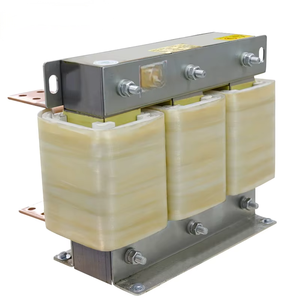
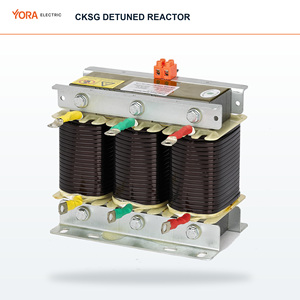
1. Three-Phase Iron-Core Dry-Type Reactors (CKSG & CKSC Series)
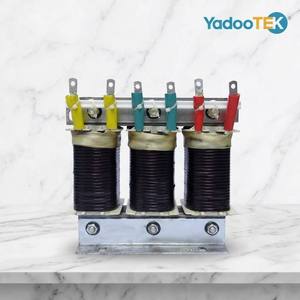
Iron-core tuning reactors utilize high-permeability, low-loss cold-rolled grain-oriented (CRGO) silicon steel sheets. The magnetic core features precision-engineered air gaps divided into uniform segments using high-temperature resin-bonded laminates. This segmented air gap structure prevents magnetic flux leakage, minimizes eddy current losses, and eliminates acoustic hum.
Key architectural highlights of our CKSG / CKSC series reactors include:
- High Linearity (K-Factor up to 2.0 In): The inductance remains stable up to twice the rated current ($2.0 \times I_n$), ensuring the reactor does not saturate during transient switching or severe voltage spikes.
- Vacuum Pressure Impregnation (VPI): Winding assemblies undergo rigorous VPI processing using Class H or Class H+ solvent-free polyester resins. This process eliminates micro-voids, delivers exceptional dielectric strength, and achieves sound levels below $48 \text{ dBA}$.
- Integrated Thermal Protection: Each phase is embedded with a micro-thermal switch (normally closed, triggering at $125^\circ\text{C}$ to $140^\circ\text{C}$) directly connected to the system protection breaker or PLC monitor.
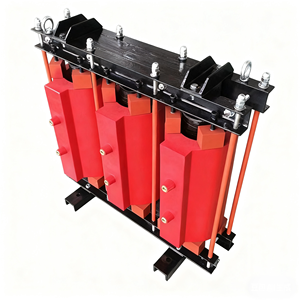
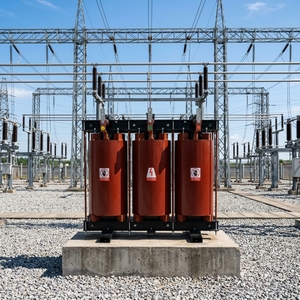
2. High-Voltage Air-Core & Epoxy-Cast Reactors (GKSC Series)
For high-voltage utility applications ($6.3\text{kV}$, $10\text{kV}$, $11\text{kV}$, up to $35\text{kV}$), GKSC series epoxy-resin cast iron-core or air-core reactors are preferred. Cast resin enclosures provide absolute protection against harsh coastal salt spray, chemical airborne contaminants, and extreme humidity levels.
Future Procurement & Technology Trends (2025–2030)
The global energy transition toward green microgrids, distributed renewable generation, and electric vehicle (EV) fast-charging infrastructure is placing unprecedented demands on power quality equipment. Sourcing managers and electrical engineers must consider the following technological shifts when procuring tuning reactors from China suppliers over the next decade:
1. Integration with Smart Grid IoT Monitoring
Modern tuning reactors are evolving from passive components into intelligent grid nodes. Next-generation CKSG/CKSC reactors incorporate embedded fiber-optic temperature sensors (PT100) and magnetic flux density transducers that communicate real-time thermal and stress metrics directly to industrial SCADA systems via Modbus or IEC 61850 protocols.
2. Ultra-Low Loss Amorphous Metal Core Coils
To reduce continuous operational carbon footprints, premium Chinese suppliers are substituting traditional silicon steel cores with amorphous alloy materials. Amorphous cores reduce no-load iron losses by up to 70%, lowering overall thermal emissions in large-scale sub-station harmonic filtering banks.
3. High-Frequency Inverter Harmonic Compensation
With Silicon Carbide (SiC) and Gallium Nitride (GaN) power electronics operating at higher switching frequencies in solar inverters, tuning reactors must handle high-frequency harmonic components (up to the 50th harmonic order) without thermal runaway or high-frequency skin-effect copper losses.
Enterprise Advantages: Why Partner with Our Manufacturing Facility
Leveraging over three decades of electrical manufacturing heritage, our state-of-the-art production base combines rigorous engineering design with world-class testing infrastructure. We provide tailored OEM/ODM solutions for international EPC contractors, panel builders, and power grid operators.
CPRI & Type-Tested Integrity
Our reactors undergo full type-testing at the Central Power Research Institute (CPRI) and hold compliance certificates for IEC 60076-6, IS 2026, and CE standards.
Customized Engineering
We supply fully customized voltage ratings (230V to 35kV), non-standard reactive power ratings (kvar), and specific inductance values tailored precisely to your harmonic audit data.
Class H Vacuum Impregnation
Utilizing high-grade copper or aluminum foil conductors wound with Class H ($180^\circ\text{C}$) insulation materials, processed under deep vacuum pressure for superior mechanical stability.
Rapid Lead Times & Global Logistics
Streamlined production scheduling guarantees 2 to 3 week manufacturing lead times for custom batches, with full seaworthy export packaging and global shipping support.