
An Industrial Step Down Transformer is a stationary electromagnetic device engineered to reduce high primary distribution voltages (such as 33kV, 22kV, 11kV, or 6.6kV) down to lower, usable secondary voltages (typically 415V, 480V, 400V, or 220V) for heavy machinery, manufacturing lines, motor control centers (MCC), and plant distribution systems. Operating on Faraday's Law of Electromagnetic Induction, the fundamental voltage ratio is directly proportional to the primary-to-secondary turns ratio ($V_p / V_s = N_p / N_s$).
In industrial environments, stepping down voltage is not merely about ratio conversion. Heavy industrial facilities experience non-linear electrical loads, extreme cyclic duty, high ambient operational temperatures, and severe short-circuit stresses. Standard distribution units often succumb to thermal runaway, insulation breakdown, or excessive harmonic heating. A purpose-built industrial step down transformer must integrate robust copper or high-grade EC aluminum conductors, high-permeability Cold Rolled Grain Oriented (CRGO) silicon steel cores, and advanced thermal management (ONAN, ONAF, AN, or AF cooling methods) to deliver 24/7 continuous operation with zero unscheduled downtime.
When procuring step-down transformers above 1000 KVA for heavy manufacturing, evaluate the Total Cost of Ownership (TCO) over a 25-year service life rather than initial capital expenditure alone. High-efficiency core laminations (such as M4 or Hi-B grade CRGO steel) and optimized coil copper density dramatically lower load and no-load losses, frequently delivering full payback on efficiency premiums within 18 to 36 months.
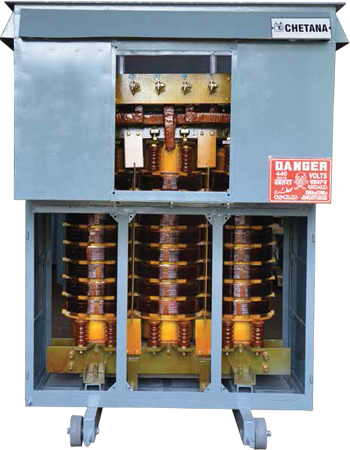
At Chetan Electric Pvt. Ltd. (established in 1994 in Bangalore, India), our engineering philosophy revolves around application-specific design customization. Standard off-the-shelf transformers fail to accommodate real-world plant operating realities like voltage drop across long cable runs, unbalanced single-phase loads, or harmonic distortion caused by Variable Frequency Drives (VFDs) and induction furnaces.
Our custom-built industrial step down transformers feature selectable vector groups (Dyn11, Dyn5, Ynd11), adjustable off-circuit or On-Load Tap Changers (OLTC) with Remote Tap Changer Cubicles (RTCC), and reinforced mechanical structures designed to withstand electromagnetic short-circuit forces tested up to 33kV utility levels.
Select the optimal transformer configuration based on your plant installation environment, fire safety compliance, and voltage regulation requirements:
Engineered for outdoor substations, mining sites, heavy industrial complexes, and primary utility step-down applications up to 5000 KVA 33kV.
Designed for indoor commercial substations, high-rise industrial complexes, chemical plants, and environments demanding maximum fire safety.
Custom engineered to handle high current secondary outputs, extreme thermal cycling, and rapid load swings in arc and induction furnaces.
Specially wound to resist stray load losses, eddy current overheating, and neutral conductor overload caused by heavy non-linear VFD loads.
The following technical parameters outline Chetan Electric’s standard step down power transformer product matrix:
| Parameter | Oil-Cooled Step Down Units | Dry-Type Step Down Units | Special Application Step Down |
|---|---|---|---|
| Rated Capacity (KVA) | Up to 5000 KVA | Up to 3150 KVA | Custom Rated per Duty Cycle |
| Primary Voltage Class | 11kV, 22kV, 33kV | 3.3kV, 6.6kV, 11kV | Up to 33kV High Current Input |
| Secondary Voltage Class | 415V, 433V, 690V, 11kV | 400V, 415V, 480V | Low Voltage High Current (e.g. 100V-300V) |
| Frequency | 50 Hz / 60 Hz | 50 Hz / 60 Hz | 50 Hz / 60 Hz / Custom High Frequency |
| Vector Group | Dyn11, Dyn5, Ynd11 | Dyn11, Dyn1 | Custom Phase-Shifted (12-Pulse/24-Pulse) |
| Winding Material | Electrolytic Copper / EC Aluminum | Electrolytic Copper / Aluminum Foil | High Conductivity Electrolytic Copper |
| Insulation & Fluid | Uninhibited Mineral Oil / Synthetic Ester | VPI Epoxy Resin Class F/H | Forced Circulation Dielectric Liquid |
| Impedance (%Z) | 4.5% to 7.5% (As per IS 2026) | 4.0% to 6.0% (As per IS 11171) | Custom High Impedance for Short Circuit Control |
| Testing Standards | IS 2026, IS 1180, IEC 60076 | IS 11171, IEC 60076-11 | IS 2026 / Special Furnace Standards |
The global industrial landscape is undergoing a massive transformation driven by energy efficiency directives, carbon neutrality targets, and Industry 4.0 automation. As a资深 SEO Growth Director and transformer engineering partner, Chetan Electric highlights the key technological trends shaping step-down transformer procurement over the next decade:
Modern global procurement managers are moving away from reactive maintenance. Smart step-down transformers are now equipped with real-time online Dissolved Gas Analysis (DGA) sensors, fiber-optic winding temperature indicators (WTI), oil level telematics, and vibration sensors. Integrated with SCADA or cloud-based predictive analytics, these units alert engineers to micro-arcing, insulation degradation, and moisture ingress before catastrophic failure occurs.
Environmental regulations are driving a shift from traditional mineral oil to biodegradable ester fluids (such as FR3 or synthetic esters). Ester fluids offer high fire flash points (>300°C compared to mineral oil's ~140°C), classifying the transformer as K-class fire safe. Furthermore, ester fluids extend paper insulation life by absorbing moisture, offering substantial long-term reliability in high-humidity industrial zones.
With global energy efficiency standards becoming stricter (such as IS 1180 Level 2 and Level 3 efficiency norms in India and EcoDesign Directive Tier 2 in Europe), step-down transformers utilizing amorphous metal cores or laser-scribed Hi-B CRGO steel are gaining market share. Amorphous cores reduce no-load core losses (hysteresis losses) by up to 70-75% compared to conventional silicon steel.
Industrial plants increasingly generate onsite power via rooftop solar PV, wind turbines, and energy storage systems (BESS). Step-down transformers are evolving to support bidirectional power flow, wide voltage variations, and high harmonic absorption without saturation, enabling seamless integration between utility power and local microgrids.
Modern manufacturing plants heavily deploy Variable Frequency Drives (VFDs), servo controllers, arc welding plants, and LED lighting. These non-linear loads inject high-frequency harmonic currents (3rd, 5th, 7th, 11th harmonics) back into the step-down transformer secondary windings.
Harmonic currents cause eddy current losses in core laminations and copper conductors to increase exponentially ($P_{ec} \propto f^2$). At Chetan Electric, our custom step-down transformers utilize transposed conductors, electrostatic ground shields between windings, and K-factor rated core geometries to safely dissipate harmonic heat without thermal de-rating.
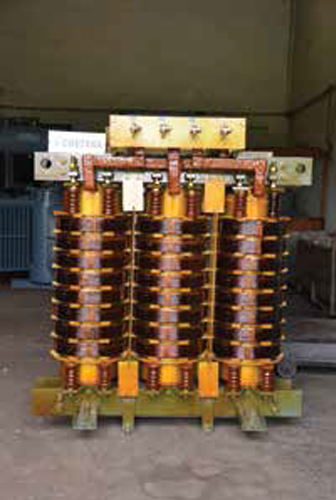
Choosing the right transformer manufacturer is a high-stakes decision for plant operations, engineering procurement contractors (EPCs), and utility executives. With over three decades of manufacturing excellence, Chetan Electric Pvt. Ltd. has established an unshakeable reputation for reliability, quality, and technical expertise.
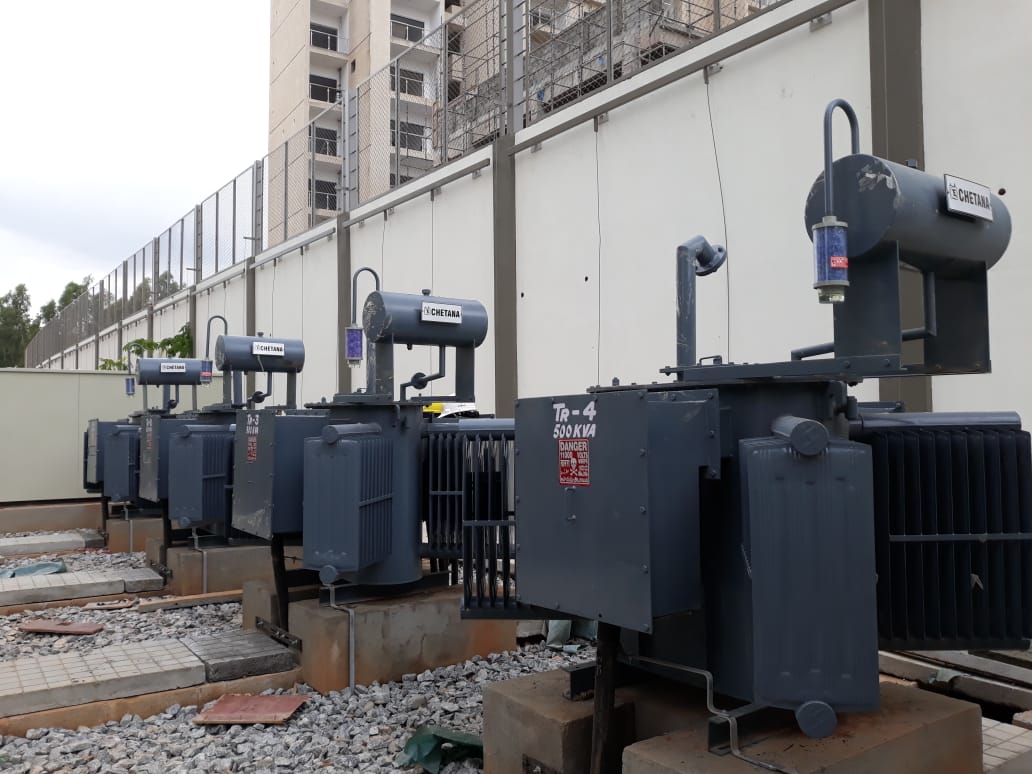
Below are detailed, authoritative answers to the most frequent technical and commercial questions submitted by global procurement teams, electrical consultants, and plant engineers when evaluating step-down transformers:
Sizing a step-down transformer for motor loads requires accounting for the locked-rotor inrush current (typically 6 to 8 times full load current) and the acceptable voltage drop during motor starting. The step-down transformer must supply the starting kVA without the secondary voltage dipping below 85-90% of nominal voltage, which could cause contactors to drop out.
The total transformer capacity ($kVA_{transformer}$) should be calculated as:
$$kVA_{transformer} \ge \frac{(kVA_{running} + kVA_{starting\_inrush})}{\% \text{Acceptable Voltage Dip Allowance}}$$
For large direct-on-line (DOL) motors, our engineers recommend deploying step-down transformers with lower percentage impedance (%Z) or utilizing autotransformers for reduced-voltage motor starting duty.
The vector group designation indicates the phase displacement and winding connection configuration between primary and secondary windings:
Impedance voltage percentage (%Z) represents the primary voltage drop across internal transformer winding resistance and leakage reactance at rated current, expressed as a percentage of rated voltage.
Chetan Electric customizes transformer %Z to match your electrical panel fault rating and utility short-circuit capacity.
Evaluating Total Cost of Ownership (TCO) involves comparing initial purchase cost, civil installation requirements, fire suppression infrastructure, maintenance overhead, and ongoing electrical losses over a 25-year lifecycle:
Non-linear power electronics (such as VFDs, rectifiers, and UPS systems) draw non-sinusoidal currents containing high harmonic orders. Harmonics increase eddy current losses in core and winding copper exponentially ($P_{eddy} \propto I_h^2 \times h^2$). A standard transformer operating under harmonic loading will overheat, age prematurely, and fail catastrophically.
A K-factor rated step-down transformer is engineered with double-sized neutral conductors, parallel thin copper strips to minimize skin effect, electrostatic shielding, and core laminations designed to operate well below magnetic saturation density under high harmonic content.
Every step-down transformer manufactured at Chetan Electric undergoes mandatory routine factory testing prior to client dispatch, including:
Standard transformers are designed for 40°C peak ambient temperatures. For installations in desert environments, tropical industrial zones, or unventilated furnace buildings where ambient temperatures exceed 50°C, Chetan Electric designs custom units with reduced winding temperature rise limits (e.g., 40°C/45°C rise instead of standard 55°C/60°C rise), oversized cooling radiators, forced air fans (ONAF), and UV-resistant outdoor paint systems (Epoxy Polyurethane coating).
Talk to Chetan Electric's senior engineering team today. Send us your primary voltage, secondary requirement, load profile, and environmental constraints. We deliver custom-engineered step-down transformers up to 5000 KVA 33kV with prompt lead times and global after-sales support.
Inquire Now