
In electrical distribution networks, municipal power grids, and industrial manufacturing plants, the Oil Immersed Distribution Transformer serves as the indispensable backbone for step-down voltage transformation and localized grid stabilization. Unlike dry-type units, liquid-filled transformers utilize dielectric fluid—traditionally refined mineral oil or modern natural synthetic esters—to achieve superior thermal dissipation, higher dielectric strength, and self-healing insulation characteristics under severe electrical overloads.
As global energy infrastructure undergoes rapid modernization driven by smart grids, renewable energy integration, and stringent carbon reduction mandates, electrical engineers and global procurement heads face complex specification decisions. Choosing the right Oil Immersed Distribution Transformer requires looking beyond nameplate rating to analyze total cost of ownership (TCO), short-circuit dynamic withstand capacity, thermal aging profiles, and environmental compliance standards such as EU EcoDesign Tier 2, IEEE C57.12.00, and IS 1180 Level 3 efficiency metrics.
1. Technical Architecture & Engineering Fundamentals
An Oil Immersed Distribution Transformer operates on electromagnetic induction, where primary high-voltage (HV) windings step down utility power (typically 11kV, 22kV, or 33kV) to utilization voltage levels (such as 415V, 433V, or 6.6kV) for industrial equipment and domestic sub-distribution. The reliability of this continuous thermal machine depends on three interconnected engineering systems: the magnetic core, the winding assembly, and the liquid-dielectric tank cooling enclosure.
Core Technical Gain: Liquid vs. Air Dielectric Physics
Liquid insulating media possess dielectric breakdown strengths (typically >60 kV across a standard 2.5mm spark gap per IEC 60156) that are almost six times higher than dry air at atmospheric pressure. Furthermore, liquid convection currents carry heat away from internal winding hotspots up to 2.5 times more efficiently than forced dry-air cooling, resulting in a substantially reduced physical footprint for transformer ratings above 1000 KVA.
1.1 Cold-Rolled Grain-Oriented (CRGO) Core Assembly
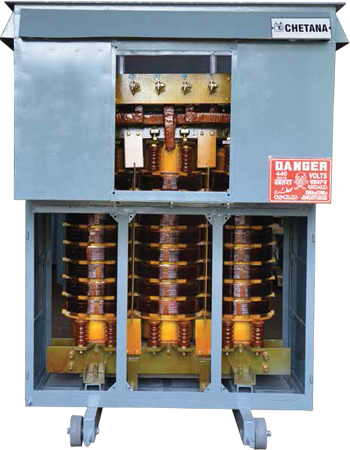
The core structure is constructed from high-grade, cold-rolled grain-oriented (CRGO) silicon steel laminations (such as M3, M4, or Hi-B domain-refined grades). Chetan Electric employs step-lap mitred joint laminations angled at 45 degrees. This design minimizes flux distortion at corner joints, reducing no-load losses (iron losses) and operational magnetizing noise in accordance with strict ambient acoustic standards.
1.2 Windings & Short-Circuit Electrodynamic Resistance
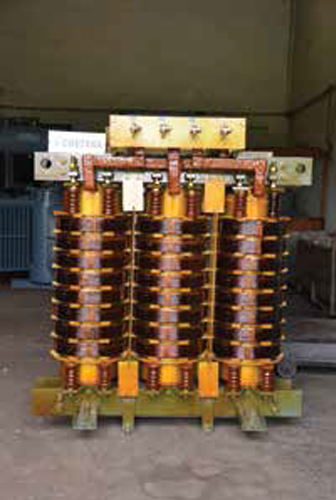
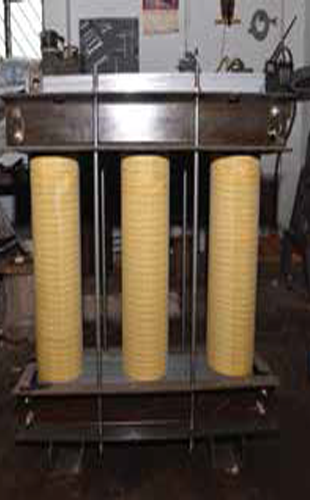
Windings are fabricated using high-conductivity, 99.9% pure electrolytic grade copper or EC grade aluminum. To withstand severe radial and axial electrodynamic forces caused by downstream external short circuits, coils are wrapped with thermally upgraded Kraft paper and mechanically clamped using rigid pressboard spacer blocks and steel clamping frames. Continuous disc or helical winding structures ensure optimized voltage distribution across turns during lightning impulses and transient switching surges.
1.3 Cooling Tank Configurations: Hermetically Sealed vs. Conservator Types
Global procurement teams must choose between two main structural housing architectures:
- Hermetically Sealed Corrugated Tank Transformers: The internal tank is completely sealed without an air cushion or external conservator. Thermal expansion of insulating liquid is absorbed by the elastic flexing of corrugated steel cooling fins. This configuration eliminates contact with atmospheric oxygen and moisture, effectively preventing oil oxidation, extending insulation paper life, and reducing routine maintenance costs.
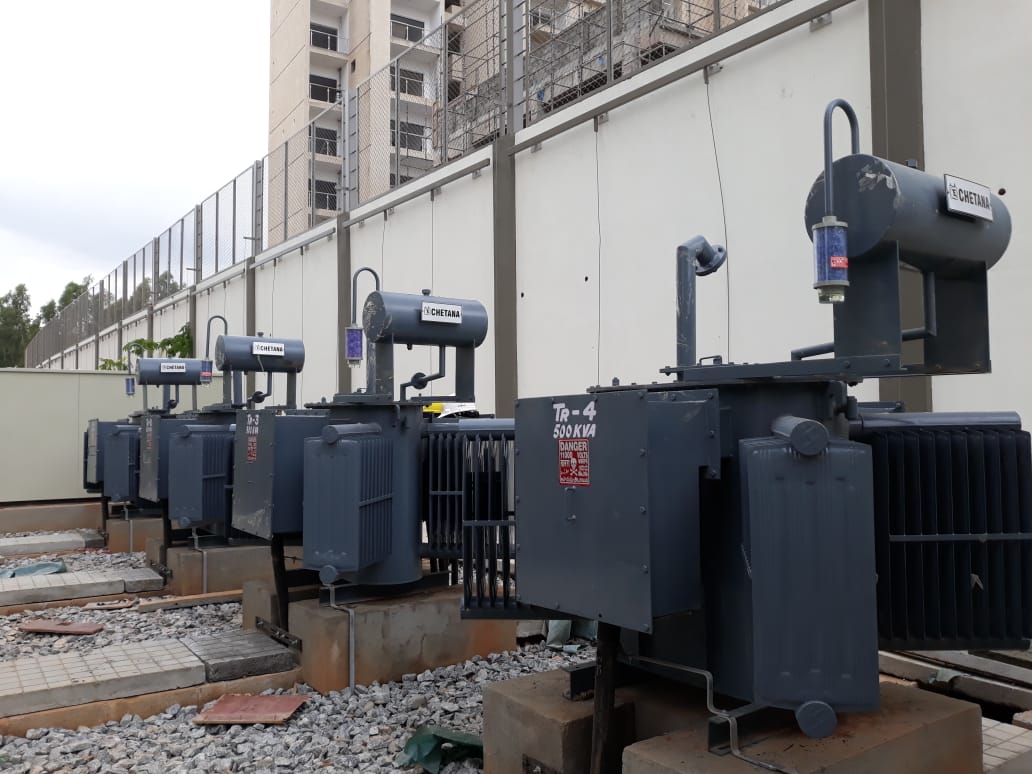
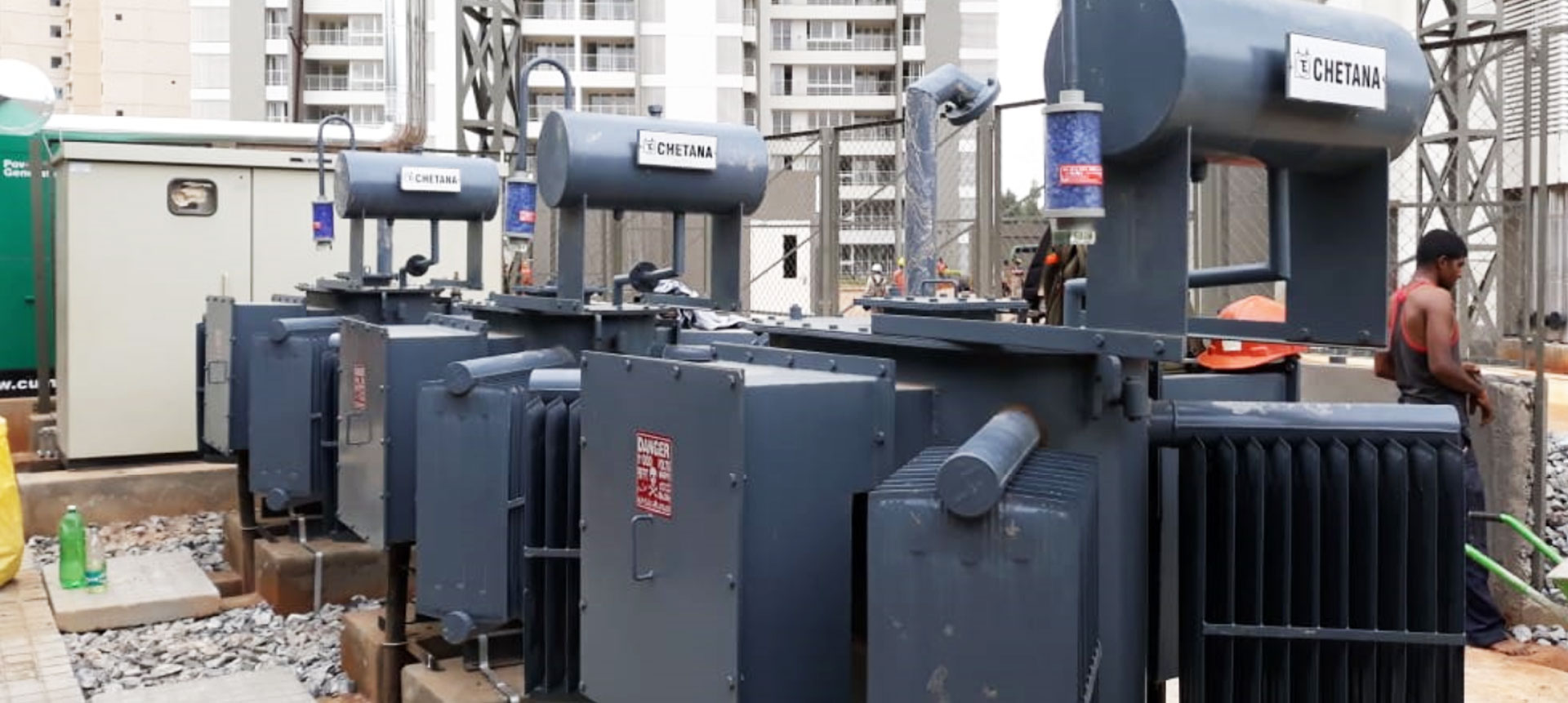
- Conservator Tank with Silica Gel Breather: Designed for larger power ratings (above 2500 KVA up to 5000 KVA) or extreme climate outdoor installations. An auxiliary expansion tank (conservator) sits above the main tank, equipped with a Buchholz relay for gas accumulation detection and a silica gel breather to strip moisture from incoming air during thermal breathing cycles.
2. Enterprise Engineering Specification Matrix
The following technical parameters outline Chetan Electric’s manufacturing capabilities for custom oil-immersed distribution transformers up to 5000 KVA and 33kV primary voltage classes:
| Parameter / Specification | Standard Industrial Range | Heavy Power / Enterprise Range |
|---|---|---|
| Rated Capacity (KVA) | 100 KVA to 1250 KVA | 1600 KVA to 5000 KVA |
| Primary Voltage Class | 11kV / 22kV (50/60 Hz) | 33kV (50/60 Hz) |
| Secondary Output Voltage | 415V, 433V (3-Phase, 4-Wire) | 3.3kV, 6.6kV, 11kV, or 433V Custom |
| Cooling Designation | ONAN (Oil Natural Air Natural) | ONAN / ONAF (Oil Natural Air Forced) |
| Insulation Liquid Options | Mineral Oil (IEC 60296 / IS 335) | Natural Ester FR3 / Bio-Oil (IEC 61099) |
| Vector Group | Dyn11 / Dyn5 / Yyn0 | Dyn11 / Custom Multi-winding Solar PV |
| Tap Changing Mechanism | Off-Circuit Tap Switch (OCTC ±5%) | On-Load Tap Changer (OLTC) with RTCC & AVR |
| Temperature Rise Limits | 50°C (Oil) / 55°C (Winding) | 50°C / 55°C (Custom reduced rise 45/50°C) |
| Standard Compliance | IS 1180, IS 2026, IEC 60076 | IEC 60076, IEEE C57.12.00, ANSI, CPRI |
3. Strategic Product Recommendations by Application
Selecting the optimal Oil Immersed Distribution Transformer requires matching specific electrical loads, environmental conditions, and regulatory compliance standards. Below are Chetan Electric’s custom product series tailored for global procurement requirements:
Standard Utility Distribution Units
Engineered for urban infrastructure, municipal housing projects, and commercial real estate complexes. Built to IS 1180 Star-Rating standards with ultra-low no-load losses and robust short-circuit capacity.
33kV Heavy Industrial & OLTC Power Units
Designed for power-intensive manufacturing, steel mills, mining operations, and large sub-station distribution. Features On-Load Tap Changers (OLTC) with Remote Tap Changer Cubicles (RTCC) for uninterrupted voltage regulation under heavy load swings.
Natural Ester (FR3) Bio-Fluid Transformers
Utilizes biodegradable, non-toxic natural ester vegetable oils with K-class fire points exceeding 300°C. Ideal for indoor-adjacent facilities, high-density residential developments, hospitals, and environmentally sensitive zones.
Renewable Energy & Inverter Duty Units
Custom multi-winding step-up transformers specifically engineered to handle high harmonic distortion, DC bias currents, and rapid power fluctuations associated with solar PV inverters and wind turbines.
4. Future Procurement Trends & Global Industry Developments
The global market for Oil Immersed Distribution Transformers is undergoing a structural shift driven by carbon neutral mandates, smart grid digitalization, and changing electrical load dynamics. Global EPC contractors, utility procurement managers, and electrical consultants must align their technical procurement specifications with four key industry vectors:
4.1 Accelerated Transition to Bio-degradable Natural Ester Fluids
Conventional naphthenic mineral oil is increasingly being replaced by natural ester fluids derived from renewable plant seeds (soybean, rapeseed). Synthetic and natural esters offer key strategic advantages for future-proofed distribution networks:
- Enhanced Fire Safety: With flash points exceeding 250°C and fire points over 300°C (K-class designation under IEC 61039), natural esters eliminate the need for costly fire-deluge walls and blast barriers in high-density urban substations.
- Extended Insulation Lifespan: Natural ester fluids absorb residual water out of cellulose insulation paper, slowing down thermal hydrolytic degradation and extending expected paper insulation life by up to 300% to 800% under heavy loading conditions.
- Environmental Protection: Achieving 99% biodegradation within 28 days (OECD 301 test), ester fluids pose no risk to water tables or soils in the event of accidental spills or tank ruptures.
4.2 Integration of AI-Driven IoT Condition Monitoring & Smart Sensors
Distribution transformers are evolving from static electrical assets into intelligent nodes within smart power grids. Modern procurement specifications increasingly mandate smart sensor suites integrated directly into liquid-filled units:
- Online Dissolved Gas Analysis (DGA): Continuous hydrogen ($H_2$) and moisture-in-oil monitoring sensors detect early-stage thermal hotspots, partial discharge, and arcing faults before catastrophic failure occurs.
- Fiber-Optic Winding Hotspot Sensing: Direct fiber-optic probes embedded inside the conductor windings provide real-time dynamic thermal loading data, enabling utilities to run dynamic overloads safely without risking insulation degradation.
- Smart Breather & Asset Health Indexing: Automated electronic breathers continuously record humidity levels and stream transformer health indicators back to centralized SCADA and enterprise asset management systems via Modbus/IEC 61850 protocols.
4.3 Total Cost of Ownership (TCO) & Amorphous Core Efficiency Mandates
Regulatory frameworks across Europe (EcoDesign Directive), North America (DOE 2016 Standards), and Asia (IS 1180 Energy Star ratings) have raised mandatory transformer efficiency thresholds. Forward-thinking buyers prioritize Total Cost of Ownership calculations over initial Capital Expenditure (CAPEX):
Strategic Formula: Evaluating Total Cost of Ownership (TCO)
$$\text{TCO} = \text{Purchase Price} + (A \times P_0) + (B \times P_k)$$
Where $P_0$ represents No-Load Iron Losses (in kW), $P_k$ represents Load Copper Losses (in kW), $A$ represents the capitalized cost per kW of no-load loss (reflecting continuous 24/7 grid connection cost), and $B$ represents the capitalized cost per kW of load loss (reflecting operational loading profiles). Purchasing lower-loss transformers with laser-scribed CRGO or Amorphous cores often yields complete CAPEX paybacks within 36 to 48 months of operation.
5. Manufacturing Authority & Enterprise Competitive Advantage
Established in 1994, Chetan Electric Pvt. Ltd. has spent over three decades establishing itself as a premier transformer manufacturing enterprise in India. Operating from Bangalore—the technological and engineering hub of India—we combine deep metallurgical, thermal, and dielectric expertise to deliver custom transformers engineered for extreme reliability.
5.1 CPRI Type-Tested Rigor & ISO 9001 Quality System
Quality and reliability are built into every stage of production at our fully equipped manufacturing facility located at the Veerasandra Industrial Area, Bangalore. Our oil-immersed distribution designs are type-tested at the prestigious Central Power Research Institute (CPRI), Bangalore, validating our design performance against severe short-circuit electromagnetic stresses, lightning impulse voltage withstand tests, and thermal temperature rise parameters per IS 2026 / IS 1180 / IEC 60076 standards.
5.2 In-House Routine & Special Diagnostic Testing
Every single unit undergoes rigorous testing prior to dispatch at our internal testing lab, including:
- Measurement of Winding Resistance and Voltage Vector Ratio
- Measurement of No-Load Losses (Iron Losses) and No-Load Current
- Measurement of Load Losses (Copper Losses) and Short-Circuit Impedance
- Separate Source AC Applied Voltage Withstand Test & Induced Overvoltage Test
- Oil Dielectric Breakdown Breakdown Voltage (BDV) & Dissipation Factor ($\tan \delta$) Analysis
5.3 Trusted Partner to Major Global & National Infrastructure Leaders
Headquartered at Raheja Arcade, Koramangala, Bangalore, Chetan Electric has earned the trust of over 600 demanding institutional, commercial, and government clients. Our transformers reliably power critical installations for industry leaders, including:
- Aero-space & Defence Institutions: Indian Space Research Organisation (ISRO), Bharat Earth Movers Limited (BEML), Bharat Electronics Limited (BEL).
- Tier-1 Real Estate & Infrastructure Developers: Prestige Group, Sobha Developers, Brigade Group, Puravankara Projects, Raheja Group, Salarpuria Properties.
- Industrial & Healthcare Sector Leaders: Nagarjuna Construction Company, Panacea Hospital, Karnataka Housing Board (KHB), KIADB Industrial Developments.